


France: Debt risks are mounting
- A narrower French bond spread has eased immediate market stress, but fiscal concerns remain unresolved.
- High public debt leaves euro area governments vulnerable to rising borrowing costs.
- Pressure on Italian bonds highlights the risk of tensions spreading beyond France.
- Stronger banks and ECB intervention tools provide greater protection than during the previous debt crisis.
- Credible fiscal reforms remain essential to restoring investor confidence.
Temporary relief offers no lasting solution
French government bonds remain under pressure as investors question the sustainability of public finances. The spread between French and German ten-year yields narrowed from almost 150 to around 140 basis points, but the improvement did not remove the underlying risks.
Marine Le Pen’s pledge to reduce the budget deficit substantially if she wins the election helped calm markets. Investors will nevertheless focus on whether those commitments can be implemented, particularly given political and public resistance to spending cuts or tax increases.

High debt revives familiar concerns
The situation shares several features with the euro area sovereign debt crisis of more than a decade ago. Public debt remains elevated, and debt-to-GDP ratios in several major economies exceed their levels before that crisis.
Across the euro area, government debt averages around 90% of GDP, compared with approximately 80% in 2009 and the EU treaty threshold of 60%. Such debt burdens make public finances more sensitive to higher borrowing costs, especially when economic growth is too weak to support a sustained reduction in debt ratios.
Contagion risks extend beyond France
Rising risk premiums on Italian bonds suggest that investors’ concerns are spreading. The scale of these moves remains considerably smaller than during the previous sovereign debt crisis, but the mechanism is familiar: higher financing costs weaken the fiscal outlook, prompting investors to demand still higher yields.
France’s economic size and the scale of its sovereign bond market make it particularly significant for the monetary union. A prolonged loss of confidence could therefore have wider consequences than stress in a smaller economy.
Political resistance complicates adjustment
A lasting reduction in the deficit would require difficult decisions on spending, taxation or both. Without sufficient political support, ambitious fiscal targets may fail to restore confidence.
Markets will consequently judge the substance and feasibility of budget measures rather than promises alone. Delays in implementing reforms could keep borrowing costs elevated and make debt stabilisation harder.
Stronger safeguards reduce crisis risks
The euro area is better equipped to withstand financial stress than it was during the previous crisis. France has a developed economy, functioning institutions and a broad tax base. European banks are also better capitalised, reducing the risk that sovereign bond losses rapidly develop into a banking crisis requiring costly government support.
The ECB’s Outright Monetary Transactions programme and Transmission Protection Instrument provide additional safeguards. Both allow intervention in bond markets under specified conditions and can help contain destabilising selling pressure. However, neither replaces credible fiscal policy, and support should not be regarded as automatic.
Fiscal credibility remains decisive
A renewed, full-scale sovereign debt crisis need not be the baseline scenario. A prolonged period of volatility and elevated French borrowing costs may be more likely.
Nevertheless, the longer France lacks a convincing plan to stabilise public debt, the greater the risk that tensions spread to other euro area economies. Institutional safeguards can limit market disruption, but a durable recovery in confidence ultimately depends on credible fiscal action.
The outlook for the stock market in France
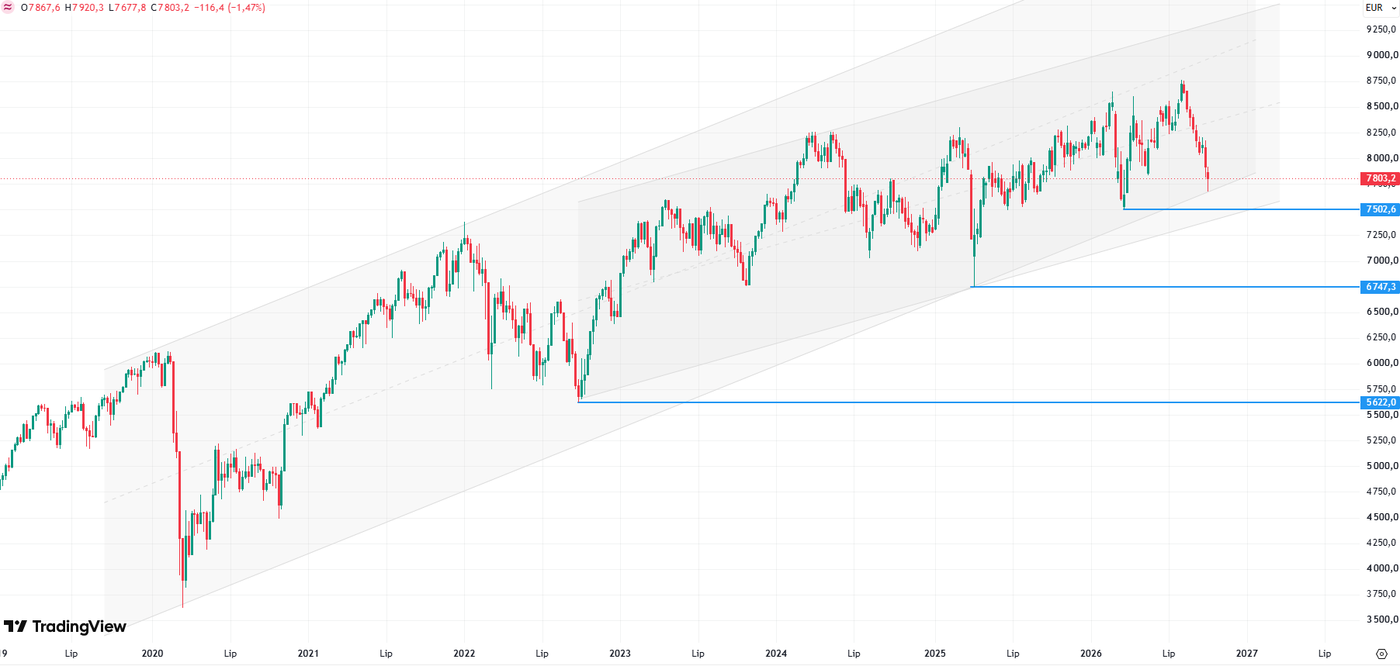
These fiscal concerns are also reflected in France’s equity market, with the CAC 40 falling sharply in recent weeks. Uncertainty over debt sustainability and the feasibility of deficit reduction is weighing on investor confidence. Banking stocks are particularly exposed, as pressure on sovereign bonds can weaken balance sheets and raise funding costs.
The chart shows the CAC 40 retreating sharply from its recent peak near 8,750 points and testing the lower boundary of its rising channel. The next key support lies around 7,500 points, with a break below it potentially opening the way towards 6,750. For now, the decline remains within the broader upward trend, although the latest sell-off has weakened the technical outlook.
Opinions are the authors'; not necessarily that of OANDA Business Information & Services, Inc. or any of its affiliates, subsidiaries, officers or directors. The provided publication is for informational and educational purposes only.
If you would like to reproduce or redistribute any of the content found on MarketPulse, an award winning forex, commodities and global indices analysis and news site service produced by OANDA Business Information & Services, Inc., please refer to the MarketPulse Terms of Use.
Visit https://www.marketpulse.com/ to find out more about the beat of the global markets.
© 2026 OANDA Business Information & Services Inc.