




NVIDIA Q3 earnings preview: Record expectations, rising risk & management stability

NVIDIA heads into its fiscal Q3 2027 earnings release with expectations of around $109 billion in revenue. Margins, cash generation, AI spending and an investigation involving CEO Jensen Huang will shape investor sentiment.
Key takeaways
- Expectations are high: Investors anticipate around $109 billion in revenue, meaning results within company guidance could still disappoint.
- Growth quality matters: Data Center dominates sales, putting margins, cash generation and the sustainability of customer AI spending under scrutiny.
- The investigation adds uncertainty: Findings involving Jensen Huang could affect management stability, business relationships and NVIDIA’s valuation.
Record expectations, rising risk & management stability
NVIDIA (NVDA) is approaching its earnings release with enormous sales growth and equally high market expectations. Investors are looking for around $109 billion in quarterly revenue. However, margins, cash flow and the outlook for spending on artificial intelligence will also shape their assessment of the report. An investigation involving Jensen Huang adds further uncertainty.
Read previous coverage: Take-Two earnings preview: GTA VI launch is the critical catalyst for TTWO
The market expects more than meeting guidance
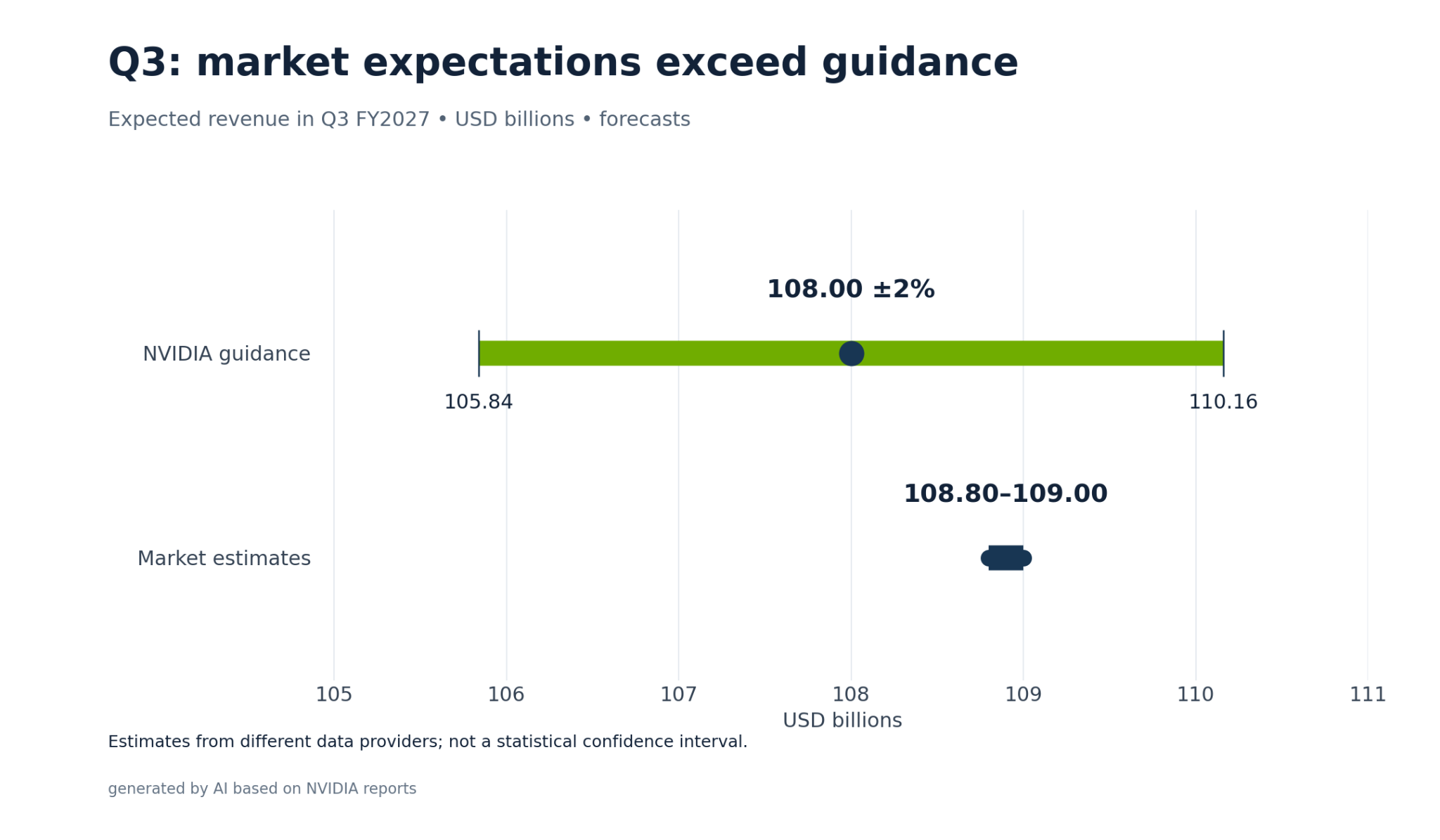
NVIDIA will report its results for the third quarter of fiscal 2027 on Tuesday, November 17. The report will cover the period ended October 25, 2026. The company has guided for revenue of $108 billion, plus or minus 2%, implying a range of $105.84 billion to $110.16 billion. The guidance excludes sales of Data Center compute chips to China.
The market estimates cited in the source material are higher, calling for revenue of $108.8–109 billion and adjusted earnings per share of $2.47–2.48. This would represent year-over-year growth of around 90% in both measures.
Even growth of this magnitude does not guarantee a positive stock market reaction. Revenue of $106–108 billion would fall within management’s guidance but could disappoint investors. Guidance for the following quarter will therefore carry considerable weight.
Data center drives scale but increases concentration
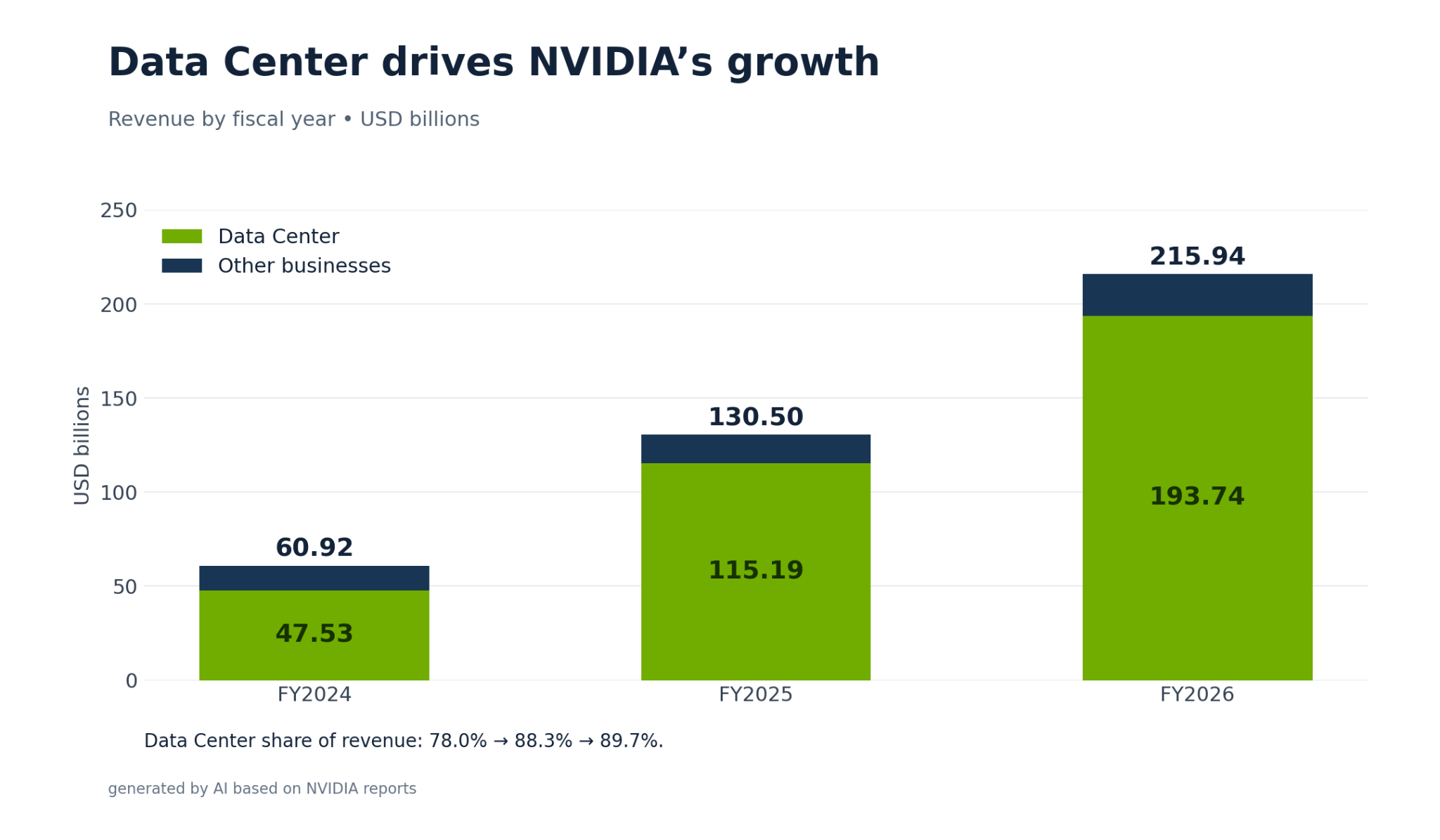
According to the data provided, Data Center revenue rose from $47.53 billion in fiscal 2024 to $193.74 billion in fiscal 2026. The segment accounted for approximately 94% of NVIDIA’s total revenue growth over that period, while its share of total revenue approached 90%.
Networking infrastructure grew particularly rapidly. Networking revenue increased by more than 141% in fiscal 2026 to $31.38 billion. NVIDIA is therefore generating revenue from an expanding share of data center infrastructure.
At the same time, the company is becoming increasingly dependent on AI investment. Gaming, automotive and professional visualization remain too small to offset a significant slowdown in its core business. Its largest customers also remain crucial: in the second quarter, Data Center sales to hyperscalers rose by 28.5% quarter over quarter, compared with 7.8% for the group comprising AI cloud providers, industrial customers and enterprises.
Margins and cash flow under scrutiny
NVIDIA expects a gross margin of 74%, plus or minus 0.5 percentage points, and approximately $9 billion in non-GAAP operating expenses. The analysis provided linked pressure on profitability to the rollout of the Vera Rubin platform and constrained availability of memory and components. The key question will be whether these costs are temporary or signal a more lasting decline in margins.
Cash flow also warrants attention. According to the data provided, second-quarter GAAP net income was $59.7 billion, operating cash flow was $24.1 billion and free cash flow was $21.3 billion. Free cash flow rose by approximately 59% year over year, while revenue increased by 106%.
This divergence does not necessarily indicate a deterioration in the business, but it does warrant scrutiny of receivables, inventories and advance payments. Reported earnings were also supported by approximately $7.8 billion in gains on equity investments before the associated tax adjustments. Earnings growth should therefore be assessed separately from the core business’s ability to generate cash.
See upcoming releases for earnings season
Huang investigation adds to uncertainty
According to Reuters, Jensen Huang acknowledged to employees that he had been unfaithful to his wife. The board of directors launched an independent investigation into the possibility that he had been targeted by a foreign intelligence service. NVIDIA stated that it had no reason to believe that company secrets or U.S. national security had been compromised. The admission of infidelity does not resolve the question of information security.
A lawsuit filed on November 9 also alleged that the company and its CEO had concealed material information. These are the plaintiffs’ allegations, not findings by a court. NVIDIA shares closed that day down 4.3%, wiping approximately $190 billion off its market capitalization. The lawsuit was filed after the market closed.
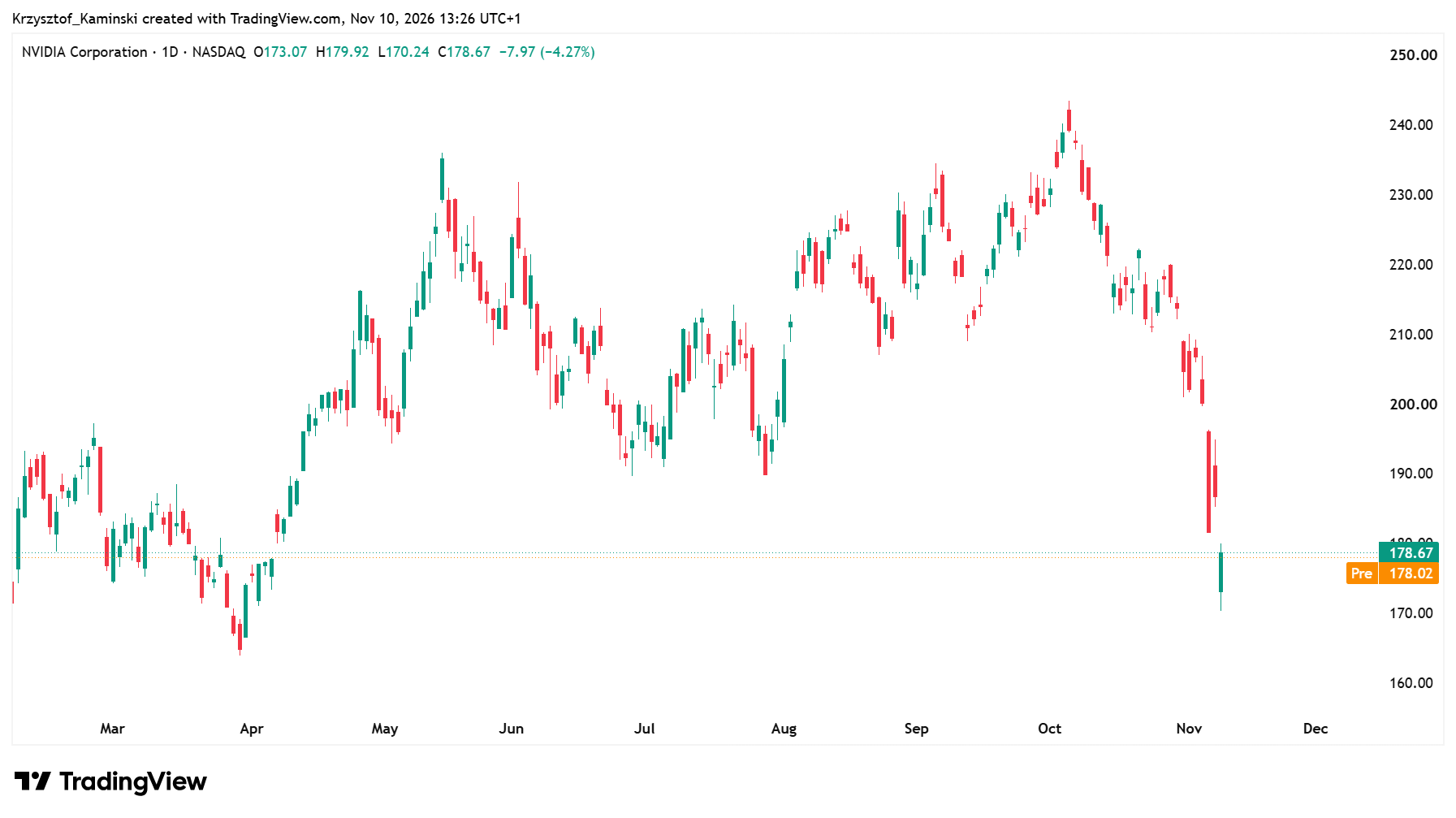
For investors, the investigation’s findings will matter, as will any potential impact on management continuity, oversight and relationships with business partners. Uncertainty could weigh on the valuation despite strong operating performance.
Record revenue is only the beginning
The most convincing report would combine revenue above expectations with disciplined margin management, strong cash generation and credible guidance for the following quarter. Results in line with guidance would confirm the enormous scale of the business but would not resolve questions about the sustainability of customer investment.
NVIDIA must therefore demonstrate that it can not only benefit from the AI boom but also maintain profitability while rolling out new products. The quality of future growth, alongside management stability, will be the most important test of the November report.
The content here is for educational and informational purposes only. This material is not investment advice or a recommendation or suggestion of any investment strategy, and it does not provide investment advisory services. OANDA is not responsible for any investment decisions made based on this content. Investing involves the risk of a loss of capital. Past performance does not guarantee future results.
Latest blog posts:


Start trading now with fast account opening.
Sign-up now to trade the most active markets
Open account

