


Wall Street under pressure: AI concerns and a strong labor market complicate the outlook
- Wall Street suffered a sharp sell-off: The S&P 500 fell 4.4% and the Nasdaq Composite dropped 5.5%, as concerns about AI infrastructure investment hit technology stocks.
- Strong employment data complicated the Fed outlook: U.S. payrolls rose by 165,000 and unemployment fell to 4.1%, giving the Fed more room to keep monetary policy restrictive.
- Living costs remained a major concern: Despite improving consumer sentiment, 57% of respondents said high prices had reduced their standard of living, while rising oil prices threatened to prolong inflationary pressure.
A sharp sell-off in technology stocks highlighted how heavily Wall Street valuations depend on expectations for the development of artificial intelligence. Concerns about the future of data center investment coincided with disappointing corporate updates. Strong U.S. labor market data released afterward further complicated the monetary policy outlook, while improving consumer sentiment failed to dispel concerns about the high cost of living.
Concerns over AI investment hit Wall Street
The November 5 trading session brought steep declines in U.S. stock indexes. The S&P 500 fell 4.4%, the Dow Jones dropped 3.4%, and the Nasdaq Composite lost 5.5%. The Nasdaq-100 declined even more sharply, falling 6.4%. Semiconductor manufacturers faced the greatest pressure, with the Philadelphia Semiconductor Index tumbling approximately 12.2%. Although technology companies were at the center of the sell-off, losses spread across all 11 S&P 500 sectors.
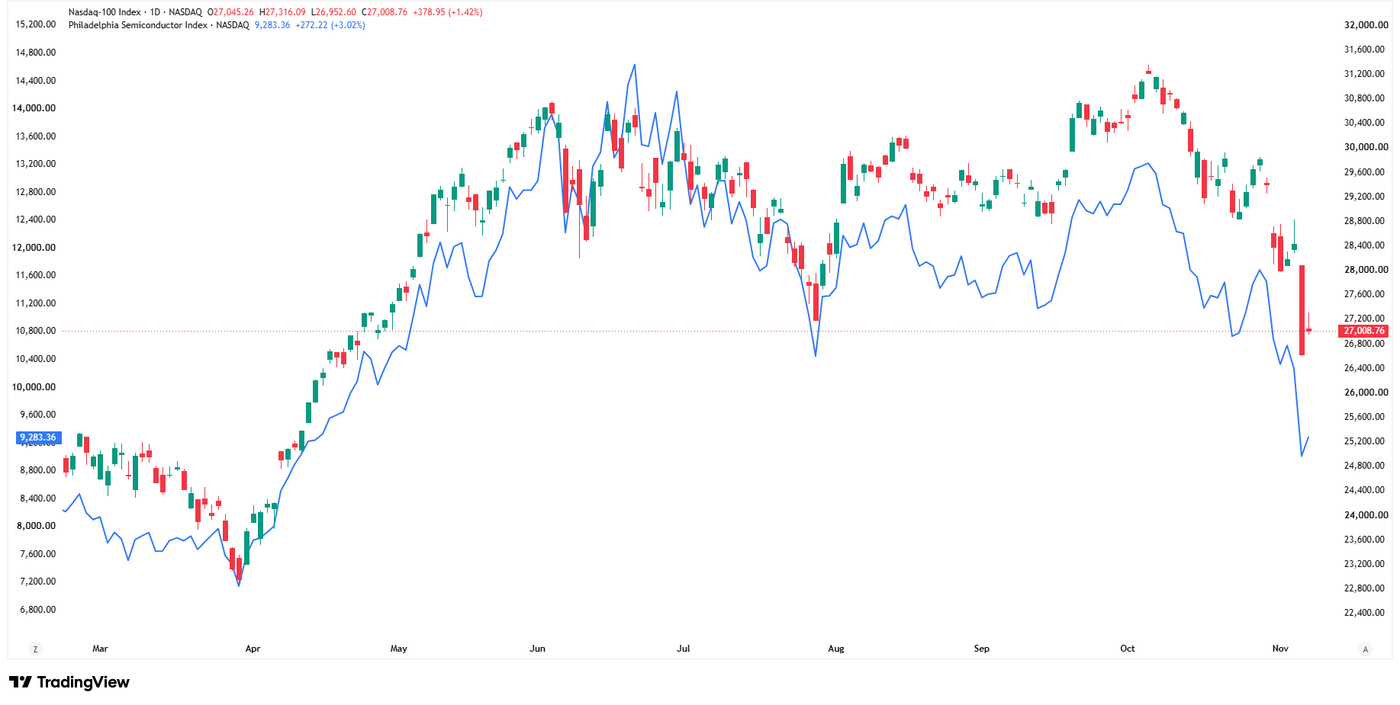
One of the main catalysts was a shift in expectations for the expansion of AI infrastructure following the U.S. elections. Victories by Democrats and candidates opposing data center expansion, including in Texas and Georgia, heightened concerns about regulatory restrictions and investment delays. Investors were responding to the risk of future policy decisions. Slower data center construction could delay orders for chips, servers, and energy infrastructure, weakening suppliers’ expected revenue growth.
High valuations amplified the disappointment
The prospect of slower investment challenged the assumptions underpinning the high valuations of AI-related companies. When investors simultaneously lower their earnings forecasts and the price they are willing to pay for future earnings, share prices can react particularly sharply. The scale of the strain was evident in infrastructure suppliers’ stocks. SanDisk shares plunged 22%, AMD, Micron, and Western Digital fell more than 17%. Nvidia dropped approximately 9%.
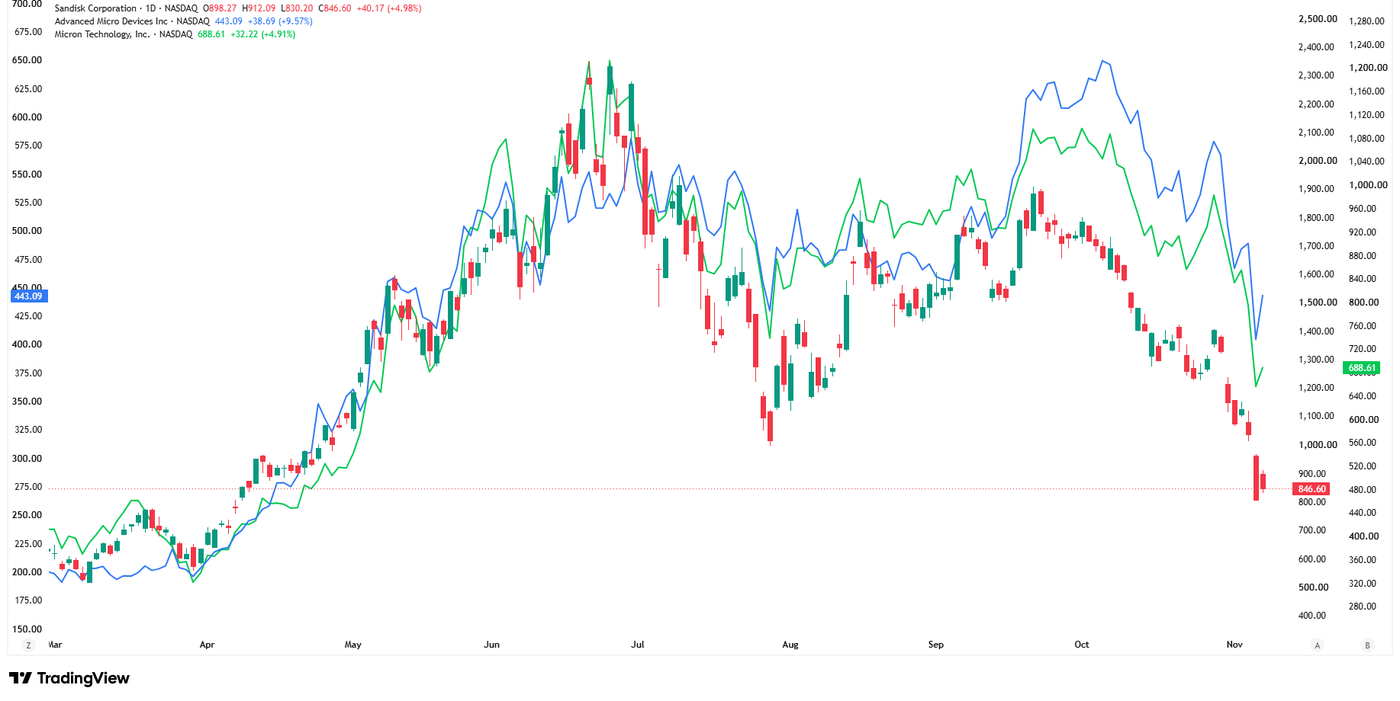
Corporate earnings and outlook updates also weighed on sentiment. Qualcomm disappointed investors with its smartphone chip sales, and its shares fell approximately 9.5%. Weakness in this segment does not necessarily indicate the state of demand for AI solutions, but it added to caution across the semiconductor industry. Funds reducing their positions and leverage may have intensified the sell-off.
A strong labor market changed the context for the Fed
Another significant development was the October employment report. Nonfarm payrolls increased by 165,000, exceeding economists’ expectations, while the unemployment rate fell to 4.1%. Revisions to the August and September figures also raised earlier estimates by a combined 84,000. Professional and business services recorded the largest employment gain, adding 70,000 jobs. Employment rose by 42,000 in health care, 25,000 in transportation and warehousing, and 19,000 in manufacturing. Private-sector employment posted its strongest increase since March.
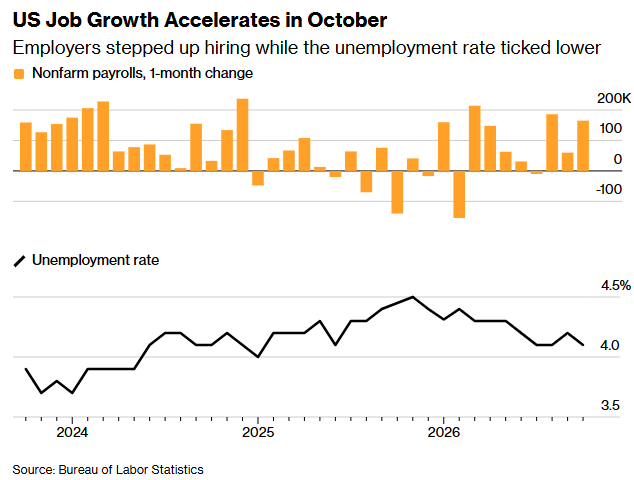
These figures highlight the difference between the economy’s current condition and stock market expectations. Technology investment continues to support economic activity and demand for workers, while equity markets are already pricing in the risk that its future growth will slow.
Job growth does not eliminate all signs of weakness
The labor market picture nevertheless remains uneven. The number of people working part time for economic reasons increased by 339,000 to 4.8 million. Meanwhile, the median duration of unemployment rose to 11.9 weeks, its highest level since 2021. Rising employment therefore coexists with difficulties faced by some Americans in finding suitable work. Wage data also sent mixed signals. Average hourly earnings rose 0.4% month over month to $38, exceeding expectations. At the same time, annual wage growth stood at 3.1%, remaining among the lowest rates recorded since 2021.
Stronger employment data give the Federal Reserve more room to maintain restrictive monetary policy. It is worth distinguishing between market reactions on successive days. During Thursday’s stock sell-off, U.S. 10-year Treasury yields fell by approximately 6 basis points, consistent with a shift away from risk. Yields on two-year Treasuries, which are more sensitive to expectations for Fed interest rates, rose only after the employment report was released.
Consumers feel an improvement, but prices still weigh
The preliminary November reading of the University of Michigan survey showed an approximately 6% increase in its consumer sentiment index. Expectations for household finances and business conditions improved. At the same time, sentiment among those with the largest stock portfolios deteriorated by 5%, a decline linked to stock market volatility.
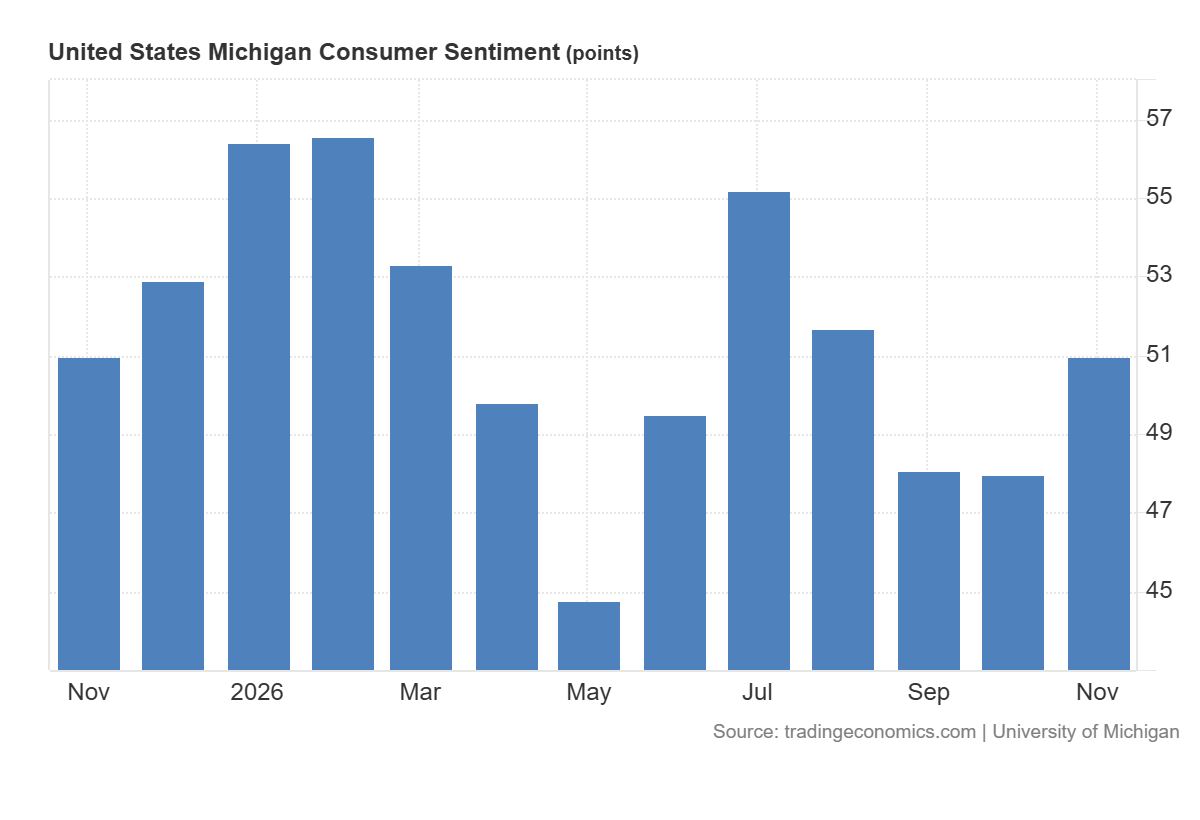
The cost of living remains the main concern. As many as 57% of respondents spontaneously reported that high prices had reduced their standard of living, compared with 46% in February. Despite November’s rebound, overall sentiment was 10% lower than in February, before the conflict with Iran began. A positive signal came from the decline in one-year inflation expectations from 4.7% to 4.3% and in long-term expectations from 3.5% to 3.4%. Both measures, however, remained elevated relative to the earlier levels cited in the survey.
Markets between economic resilience and valuation uncertainty
An additional burden for investors was an approximately 3.9% rise in Brent crude prices to $98.29 a barrel, amid continued uncertainty surrounding the war with Iran. Higher energy prices could make it harder to curb price pressures, even as consumers’ inflation expectations gradually decline.
The U.S. economy continues to show resilience, but strong data are not necessarily unambiguously good news for the stock market. Stable employment supports incomes and consumption while reducing pressure to ease monetary policy. Under these conditions, sustaining high technology stock valuations requires evidence that AI investment will deliver the expected earnings growth. November’s sell-off demonstrated how sharply markets can react when confidence in that scenario begins to weaken.
Opinions are the authors'; not necessarily that of OANDA Business Information & Services, Inc. or any of its affiliates, subsidiaries, officers or directors. The provided publication is for informational and educational purposes only.
If you would like to reproduce or redistribute any of the content found on MarketPulse, an award winning forex, commodities and global indices analysis and news site service produced by OANDA Business Information & Services, Inc., please refer to the MarketPulse Terms of Use.
Visit https://www.marketpulse.com/ to find out more about the beat of the global markets.
© 2026 OANDA Business Information & Services Inc.