








USD/JPY Price Forecast: Fresh downside leg expected below 155.00
- USD/JPY flattens at around 156.00 at the start of the week.
- The JPY outperformed last week after hawkish remarks from BoJ’s Takata.
- Investors keenly await the US CPI data for August.
The Japanese Yen (JPY) trades flat against the US Dollar (USD) at around 156.00 at the start of the week, but is close to its four-month low of 155.23. The pair is broadly firm due to JPY’s last week's outperformance, which came on the back of hawkish commentary from Bank of Japan’s (BoJ) board member Hajime Takata.
Yen surge raises questions over BoJ intervention and rate path
Analysts at MUFG highlight that there were “significant moves in the FX market, with the Japanese yen in particular strengthening sharply from the 160 level on 2 Sep all the way down to as low as 155.30 overnight, a 5 big figure move.” They note that it came more broadly on the policy backdrop, flagging that “BoJ Board Member Takata – one of BOJ’s most hawkish members – gave a speech earlier this week leaving the door open for an outsized interest rate increase as well as back-to-back hikes,” reinforcing market speculation that the BoJ could countenance a more aggressive tightening path if conditions warrant.
MUFG also flagged a weak US Dollar as another trigger for significant weakness in the US Dollar, and ruled out the possibility of BoJ’s intervention. “It is not entirely clear whether the moves in USD/JPY were driven by FX intervention,” although “BoJ current account data for Wednesday do not suggest the moves were driven by intervention,” pointing instead to broader Dollar weakness and regional FX gains as key drivers, MUFG said.
Meanwhile, investors await the United States (US) Consumer Price Index (CPI) data for August, which will be published on Friday. The US inflation data is expected to have a significant impact on the Federal Reserve’s (Fed) interest rate expectations.
USD/JPY Technical Analysis
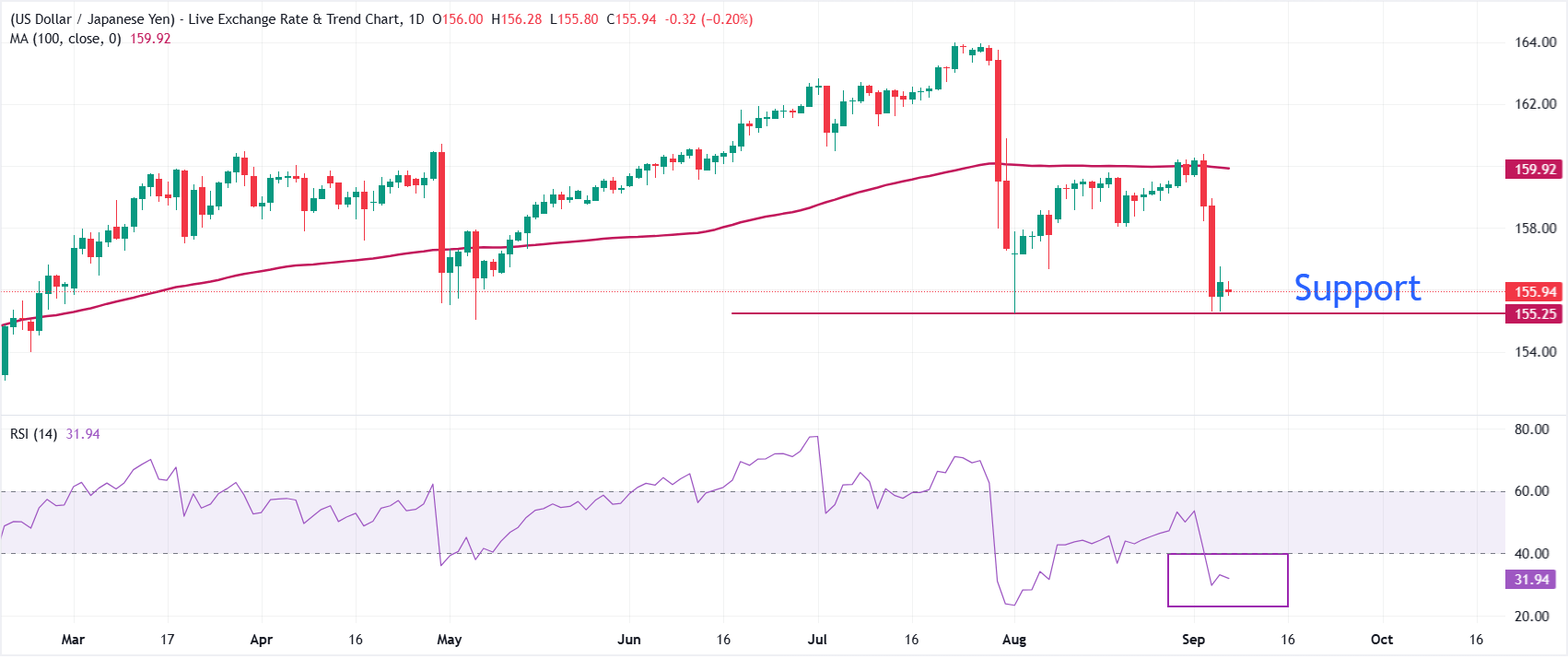
In the daily chart, USD/JPY trades at 155.95, keeping a bearish near-term bias as spot holds well below the 100-day Simple Moving Average (SMA) at 159.92. The distance to this SMA suggests the broader uptrend framework remains above price, with sellers in control for now.
The Relative Strength Index (RSI) at about 32 hovers just above oversold territory, hinting that downside momentum is stretched but not yet signaling a confirmed reversal.
On the topside, the 100-day SMA at 159.92 is the first meaningful resistance that bulls would need to reclaim to ease the current downside pressure and reopen a path toward higher levels. Looking down, the four-month low at 155.25 is the key support zone; below that, the pair could face a fresh downside leg.
(The technical analysis of this story was written with the help of an AI tool. Know more.)
Bank of Japan FAQs
What is the Bank of Japan?
The Bank of Japan (BoJ) is the Japanese central bank, which sets monetary policy in the country. Its mandate is to issue banknotes and carry out currency and monetary control to ensure price stability, which means an inflation target of around 2%.
What has been the Bank of Japan’s policy?
The Bank of Japan embarked in an ultra-loose monetary policy in 2013 in order to stimulate the economy and fuel inflation amid a low-inflationary environment. The bank’s policy is based on Quantitative and Qualitative Easing (QQE), or printing notes to buy assets such as government or corporate bonds to provide liquidity. In 2016, the bank doubled down on its strategy and further loosened policy by first introducing negative interest rates and then directly controlling the yield of its 10-year government bonds. In March 2024, the BoJ lifted interest rates, effectively retreating from the ultra-loose monetary policy stance.
How do Bank of Japan’s decisions influence the Japanese Yen?
The Bank’s massive stimulus caused the Yen to depreciate against its main currency peers. This process exacerbated in 2022 and 2023 due to an increasing policy divergence between the Bank of Japan and other main central banks, which opted to increase interest rates sharply to fight decades-high levels of inflation. The BoJ’s policy led to a widening differential with other currencies, dragging down the value of the Yen. This trend partly reversed in 2024, when the BoJ decided to abandon its ultra-loose policy stance.
Why did the Bank of Japan decide to start unwinding its ultra-loose policy?
A weaker Yen and the spike in global energy prices led to an increase in Japanese inflation, which exceeded the BoJ’s 2% target. The prospect of rising salaries in the country – a key element fuelling inflation – also contributed to the move.