








Gold Price Forecast: XAU/USD sits out the panic it was built for
- XAU/USD trades near $4,020 after shedding roughly 1.4%, printing the day's low in the minutes after a soft July confidence survey.
- Korean equities fell almost 11% and the semiconductor complex was sold worldwide, and none of that fear reached the metal.
- The Federal Reserve decision lands Wednesday evening with a hike tail above a third and no cut priced anywhere on the 2026 curve.
Gold trades near $4,020 in the New York morning, down roughly 1.4% on a session that started near $4,075 and never built a bid. The slide ran straight through a global equity shock that should have been the strongest advertisement for the metal in months, and the day's low printed just above the $4,000 handle instead.
A fear trade that skipped the fear asset
The damage overnight was concentrated in Asia, where Korean shares fell almost 11% as the two largest memory makers there dropped double digits, the Nikkei 225 gave up close to 4% and the regional benchmark fell 3%. Renewed scepticism about the returns on artificial intelligence spending did the work. Money moved into safety, and it moved into government bonds and the Dollar rather than into bullion.
The Dollar Index sits near 101.50 at a one-month high and the Dollar trades just short of 164.00 against the Yen. Treasury yields eased on the equity move, which ordinarily supports an asset that pays no coupon. Gold fell anyway, which says the bid for protection is being expressed in currency and duration and not in metal.
The other bid the metal has lost is the war, and the pause in that war is now four days old. American strikes on Iran are on hold for a fourth day, with Washington claiming Tehran asked for the pause and Tehran denying any negotiation is under way beyond talks with Oman on safe passage. Shipping through the Strait of Hormuz still runs at fewer than 10 vessels a day against roughly 100 before the conflict, so the chokepoint remains shut in practice while the price behaves as though it is open.
One variable, and it reports on Wednesday
The metal has spent July trading a single input, and that input reports at 18:00 GMT on Wednesday. The hike tail for this meeting has been pinned near 36% since the middle of last week, unmoved by the stand-down in the Gulf and by a 7% break in Crude Oil, with at least one increase roughly 80% priced by September and no cut anywhere on the 2026 curve.
June's inflation print did the rest of the damage, and the arithmetic behind it is not subtle. Headline at 3.5% YoY against an upper bound of 3.75% flipped the real policy rate back to positive after two months underwater, and core at 2.6% widens that gap to more than a full point. A metal that pays nothing cannot argue with a policy rate that might rise and will not fall.
The owners changed, and the story did not
June fund flows explain the shape of this tape better than any headline does. Physically backed exchange-traded products shed roughly 8.9 billion Dollars over the month per World Gold Council data, cutting holdings by 74 tonnes to just above 4K tonnes, with the bulk of the exit in North America as investors chased yield elsewhere. The first half still ran positive at roughly 8 billion Dollars of net inflows, and Asian funds took a record 12 billion Dollars of that.
That regional split explains a tape that neither breaks down nor recovers. Western allocators sell the metal when real rates rise, and Asian buyers accumulate it for reasons that have nothing to do with the next Federal Reserve meeting. The result is a floor just under $3,950 that keeps holding while every rally since June dies beneath the moving averages, with a drawdown of roughly 28% from January's record near $5,600 producing no capitulation at all.
The data the metal has to survive
Wednesday's decision arrives without a fresh set of projections, so the statement language and the press conference at 18:30 GMT carry the entire signal. Thursday brings the June core Personal Consumption Expenditures price index at 12:30 GMT, with consensus at 0.2% MoM and 3.3% YoY against 0.3% and 3.4% previously, alongside the first estimate of second-quarter Gross Domestic Product at 2.1% annualized and jobless claims at 200K against 187K.
The American evidence this week has been soft and the metal has not been paid for it. The four-week average of private hiring slowed again to 15K from 16.25K, and July confidence moderated to 90.8 against expectations nearer 92, with the present situation index weaker for a third consecutive month and the expectations component still beneath the 80 line historically associated with recession risk. Soft data buys Gold only when it buys rate cuts, and it no longer buys rate cuts.
Technical levels
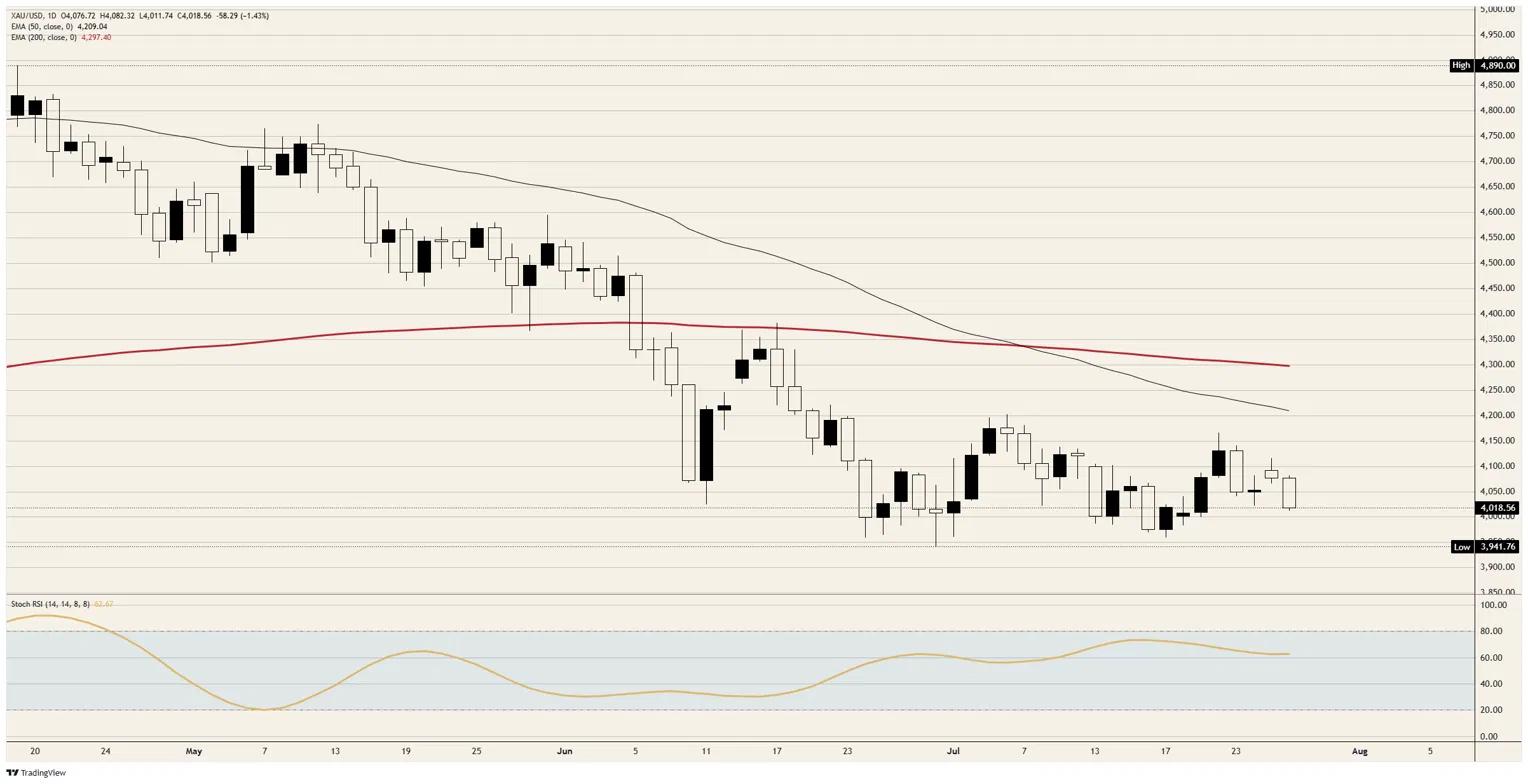
Resistance: The session ceiling near $4,075 is the first line, with the $4,150 area that has capped every attempt this month above it, and the 50-day Exponential Moving Average (EMA) near $4,200 marking the structural cap after crossing beneath the 200-day near $4,300 earlier in July.
Support: The $4,000 handle is the only level that matters into the decision, and beneath it the late-June low just under $3,950 is the floor of the entire summer range.
Bias: Bearish. Rallies into $4,075 are for selling while both averages decline overhead, with the $4,000 handle and then $3,950 as objectives, and the daily Stochastic Relative Strength Index near 63 leaves room beneath. A daily close above $4,150 invalidates.
XAU/USD daily chart
Gold FAQs
Why do people invest in Gold?
Gold has played a key role in human’s history as it has been widely used as a store of value and medium of exchange. Currently, apart from its shine and usage for jewelry, the precious metal is widely seen as a safe-haven asset, meaning that it is considered a good investment during turbulent times. Gold is also widely seen as a hedge against inflation and against depreciating currencies as it doesn’t rely on any specific issuer or government.
Who buys the most Gold?
Central banks are the biggest Gold holders. In their aim to support their currencies in turbulent times, central banks tend to diversify their reserves and buy Gold to improve the perceived strength of the economy and the currency. High Gold reserves can be a source of trust for a country’s solvency. Central banks added 1,136 tonnes of Gold worth around $70 billion to their reserves in 2022, according to data from the World Gold Council. This is the highest yearly purchase since records began. Central banks from emerging economies such as China, India and Turkey are quickly increasing their Gold reserves.
How is Gold correlated with other assets?
Gold has an inverse correlation with the US Dollar and US Treasuries, which are both major reserve and safe-haven assets. When the Dollar depreciates, Gold tends to rise, enabling investors and central banks to diversify their assets in turbulent times. Gold is also inversely correlated with risk assets. A rally in the stock market tends to weaken Gold price, while sell-offs in riskier markets tend to favor the precious metal.
What does the price of Gold depend on?
The price can move due to a wide range of factors. Geopolitical instability or fears of a deep recession can quickly make Gold price escalate due to its safe-haven status. As a yield-less asset, Gold tends to rise with lower interest rates, while higher cost of money usually weighs down on the yellow metal. Still, most moves depend on how the US Dollar (USD) behaves as the asset is priced in dollars (XAU/USD). A strong Dollar tends to keep the price of Gold controlled, whereas a weaker Dollar is likely to push Gold prices up.