









EUR/USD surges then falls back into near-term median after US PMI surges above forecasts
EUR/USD knocks back after a firm rally as safe-haven bids step up. US PMI beats take center stage as rate cut hopes wither further. A beat for the EU Manufacturing PMI helped kick off a EUR/USD climb.The EUR/USD drove back into the high side near 1.0930 on Wednesday after markets shrugged off a miss for pan-European Purchasing Managers Index (PMI) figures before a follow-up beat in US PMIs sent risk appetite skidding back into the safe havens. The pair gained over a full percent bottom-to-top climbing from the previous day’s low of 1.0821 before getting pushed back into a familiar technical level near 1.0900.
European PMIs broadly printed in the sub-50.0 region, suggesting the broader euro area economy remains in contraction territory, and nearly all missed market expectations with the exception of a single bright spot in the manufacturing sector. Meanwhile, US PMIs broadly beat the Street, with a climb to multi-month highs in both manufactured goods and the service sector.
Daily digest market movers: EUR/USD rally gets cut short after US PMIs tarnish rate outlook once more European PMIs broadly missed expectations, but a beat in the Manufacturing PMI helped bolster the mood as investors search for a Euro win. The pan-European Manufacturing PMI printed at 46.6 in January, above the forecasted 44.8 and climbing even higher above the previous month’s 44.4. The Europe-wide PMI Services component fell to 48.4, missing the forecast of 49.0 and slipping back further from December’s 48.8. European Manufacturing PMIs climbed to a ten-month high, extending a recovery from multi-year lows and bolstering the Euro (EUR). US PMIs broadly beat market expectations to print healthy gains in business activity, crumpling rate cut hopes even further and sending traders back into the US Dollar in the mid-week market session. January’s US Manufacturing PMI climbed to a 15-month high of 50.3, returning to expansion territory above 50.0 and easily beating the market forecast of a steady print at December’s 47.9. The US Services PMI for January also jumped forecasts to print at 52.9 versus the forecasted decline from 51.4 to 51.0. EUR-based pairs will be turning to face Thursday’s European Central Bank (ECB) rate call. Markets are broadly looking for rate cuts from the ECB to begin sometime around the midpoint of 2024. ECB Preview: Forecasts from 12 major banksThe table below shows the percentage change of Euro (EUR) against listed major currencies today. Euro was the strongest against the Canadian Dollar.
USD EUR GBP CAD AUD JPY NZD CHF USD -0.37% -0.46% 0.17% -0.27% -0.67% -0.39% -0.78% EUR 0.37% -0.09% 0.53% 0.06% -0.29% -0.03% -0.42% GBP 0.46% 0.09% 0.62% 0.16% -0.21% 0.06% -0.31% CAD -0.17% -0.51% -0.62% -0.47% -0.84% -0.57% -0.95% AUD 0.29% -0.07% -0.17% 0.45% -0.33% -0.12% -0.50% JPY 0.65% 0.28% 0.21% 0.79% 0.38% 0.25% -0.13% NZD 0.41% 0.00% -0.07% 0.54% 0.10% -0.26% -0.41% CHF 0.78% 0.41% 0.32% 0.94% 0.50% 0.12% 0.39%The heat map shows percentage changes of major currencies against each other. The base currency is picked from the left column, while the quote currency is picked from the top row. For example, if you pick the Euro from the left column and move along the horizontal line to the Japanese Yen, the percentage change displayed in the box will represent EUR (base)/JPY (quote).
EUR/USD finds itself getting dumped back into the 1.0900 handle near the 200-hour Simple Moving Average (SMA) on Wednesday as the pair struggles to find real momentum, keeping the pair pinned to near-term technical levels amidst a broader push into mid-term consolidation. A widening consolidation range is highlighting the increased volatility in the EUR/USD despite keeping the pair close to long-term support near 1.0850.
Daily candlesticks have the EUR/USD stuck in the middle of a consolidation pattern between the 50-day and 200-day SMAs at 1.0920 and 1.0850, respectively. The Euro-Dollar pair is set to drift until a meaningful push develops in either direction.
EUR/USD Hourly Chart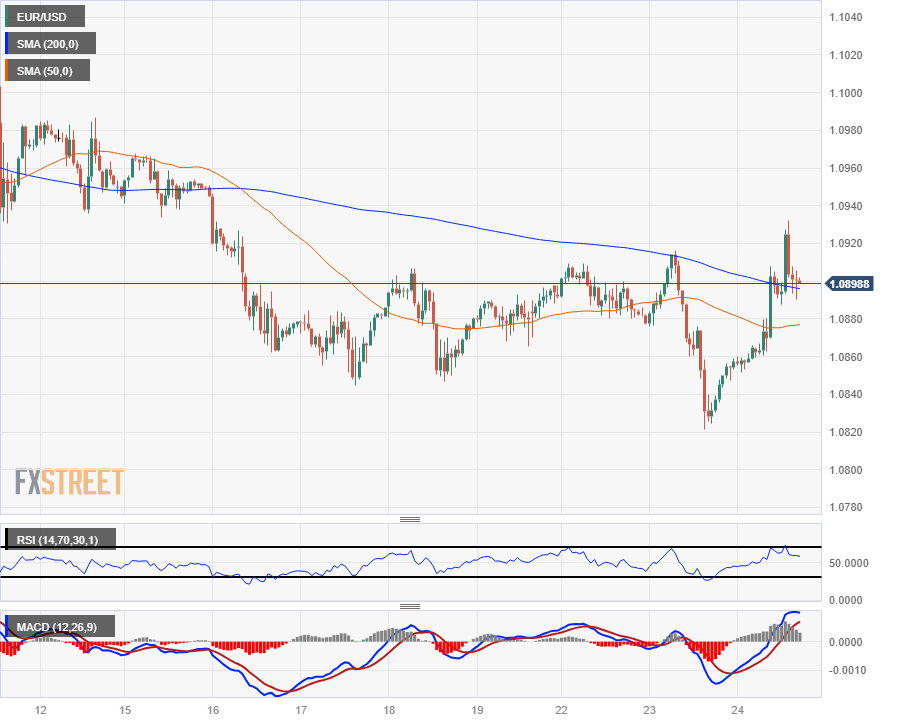 EUR/USD Daily Chart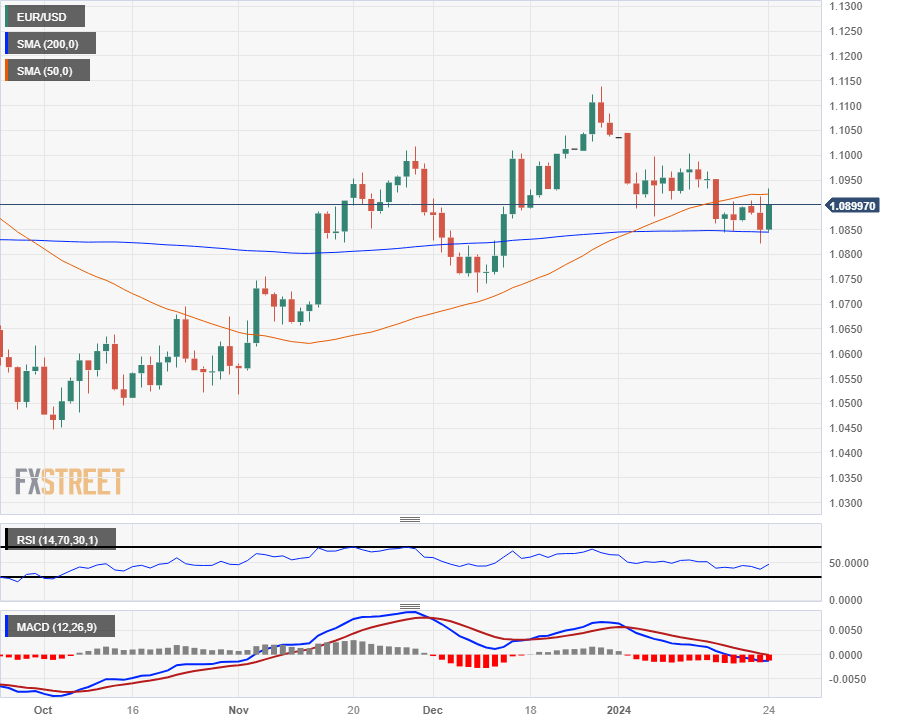
The European Central Bank (ECB) in Frankfurt, Germany, is the reserve bank for the Eurozone. The ECB sets interest rates and manages monetary policy for the region.
The ECB primary mandate is to maintain price stability, which means keeping inflation at around 2%. Its primary tool for achieving this is by raising or lowering interest rates. Relatively high interest rates will usually result in a stronger Euro and vice versa.
The ECB Governing Council makes monetary policy decisions at meetings held eight times a year. Decisions are made by heads of the Eurozone national banks and six permanent members, including the President of the ECB, Christine Lagarde.
In extreme situations, the European Central Bank can enact a policy tool called Quantitative Easing. QE is the process by which the ECB prints Euros and uses them to buy assets – usually government or corporate bonds – from banks and other financial institutions. QE usually results in a weaker Euro.
QE is a last resort when simply lowering interest rates is unlikely to achieve the objective of price stability. The ECB used it during the Great Financial Crisis in 2009-11, in 2015 when inflation remained stubbornly low, as well as during the covid pandemic.
Quantitative tightening (QT) is the reverse of QE. It is undertaken after QE when an economic recovery is underway and inflation starts rising. Whilst in QE the European Central Bank (ECB) purchases government and corporate bonds from financial institutions to provide them with liquidity, in QT the ECB stops buying more bonds, and stops reinvesting the principal maturing on the bonds it already holds. It is usually positive (or bullish) for the Euro.