










Chart alert: USD/JPY plummeted 0.5% on suspected deliberate intervention, key levels to watch ahead of NFP
Key takeaways
- USD/JPY's sharp intraday reversal bears the hallmarks of official intervention. The sudden 0.5% decline during the Asian-London session, coupled with reports that Japanese authorities may be shifting toward less predictable intervention tactics, suggests policymakers are attempting to curb speculative yen selling without fundamentally altering the prevailing uptrend.
- Interest-rate differentials continue to favour a stronger US dollar. The widening 2-year US Treasury-JGB yield spread and expectations for a resilient US labour market remain supportive of USD/JPY. A stronger-than-expected US non-farm payrolls report could reinforce expectations of further Federal Reserve tightening and renew upward pressure on the pair.
- Crowded speculative positioning raises the risk of sharp squeezes. Net short positions in Japanese yen futures remain near two-year highs, increasing the likelihood that targeted intervention or even the threat of intervention could trigger rapid short-covering rallies without necessarily reversing the broader trend.
- The 160.90 level is the key technical line in the sand. Holding above this support keeps the medium-term bullish outlook for USD/JPY intact, while a decisive break below it would signal that intervention has evolved from a temporary squeeze into a deeper corrective phase.
Out of the blue, the Japanese yen recovered sharply by 0.5% against the US dollar on Thursday, 2 July 2029, at 2 pm SG time (the Asian-to-London handover period).
The USD/JPY staged a steep intraday decline of 0.5% to trade at 161.70 at the time of writing, back below the prior 161.95 (former major resistance from early July 2024 swing highs and prior BoJ intervention).
This type of swift movement smells like FX intervention. So far, there are no official announcements from Japanese authorities, except for a report from Reuters that stated that “Japanese officials are abandoning their habit of telegraphing intervention risks, instead signalling a more targeted campaign to squeeze speculators and raise the cost of betting against the battered yen,” according to sources.
Could it be a deliberate attempt to smooth speculative activities ahead of NFP?
So far, fundamentals have been supportive of a weaker Japanese yen, in line with softer oil prices, where benchmark crude oil, Brent and WTI have fallen to below $75 per barrel, keeping a lid on the Japanese inflation trend, in turn, reducing the hawkish rhetoric from the Bank of Japan (BoJ).
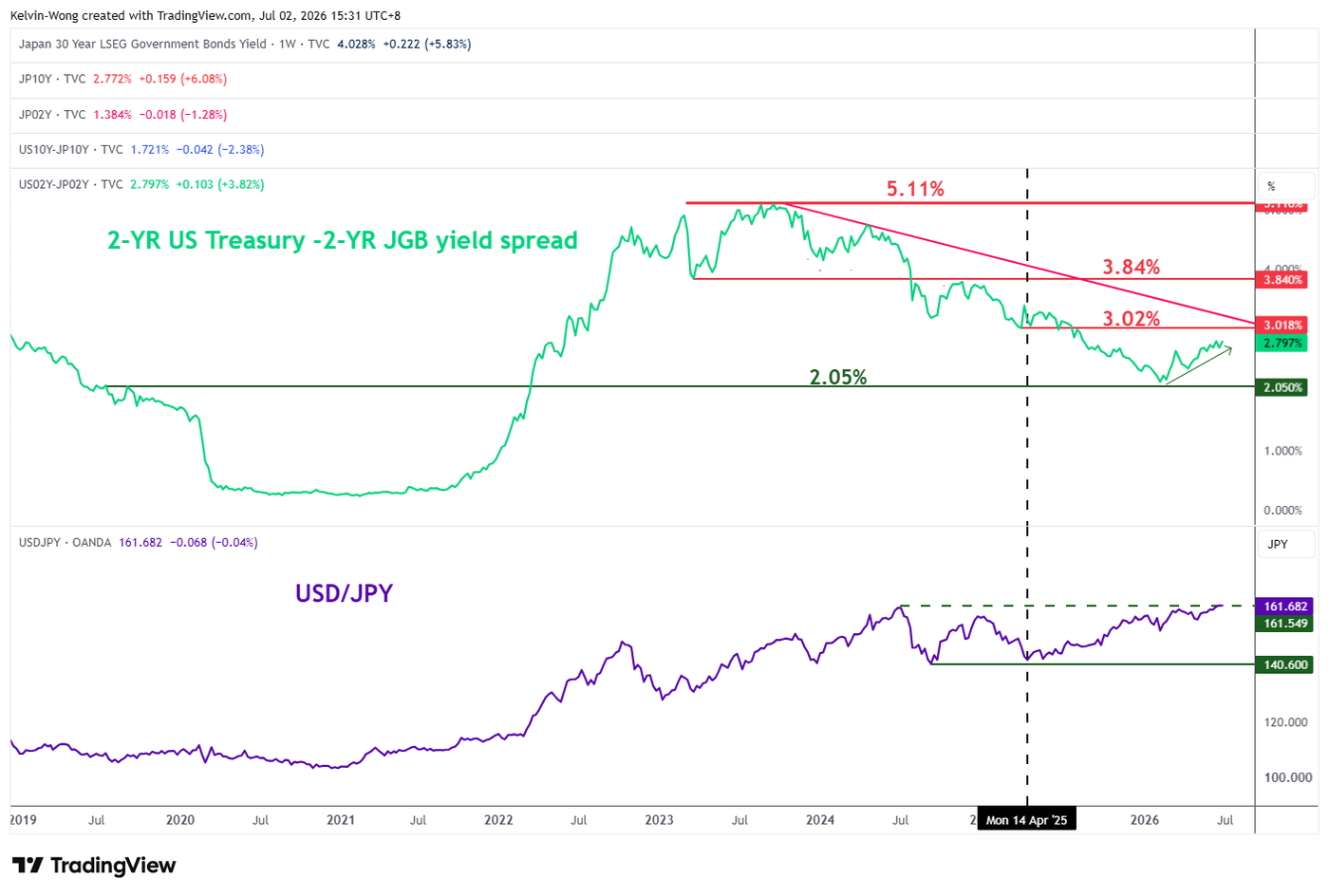
All these factors allow the monetary policy sensitive 2-year yield spread between the US Treasury Notes and the Japanese Government Bonds (JGBs) to widen further, as the yield premium is now inching higher to 2.79% at this time of writing, making short-term US fixed income more attractive than Japanese ones, in turn, putting upside pressure on the USD/JPY (see Fig. 1).
Hence, a red-hot US non-farm payrolls data for June (above consensus of 110k, and 172K in May) later is likely to increase a more hawkish pricing of the US Federal Reserve’s future monetary policy, pushing up the 2-year US Treasury and JGB yield spread higher above 2.79%, in turn, triggering more speculators to take on short positions on the Japanese yen.
A swift weakening of the Japanese yen may create some “undesirable fundamental” impact on the Japanese economy, such as softening domestic spending and consumer confidence, offsetting the marginal benefits gained from Japanese automobile exporters.
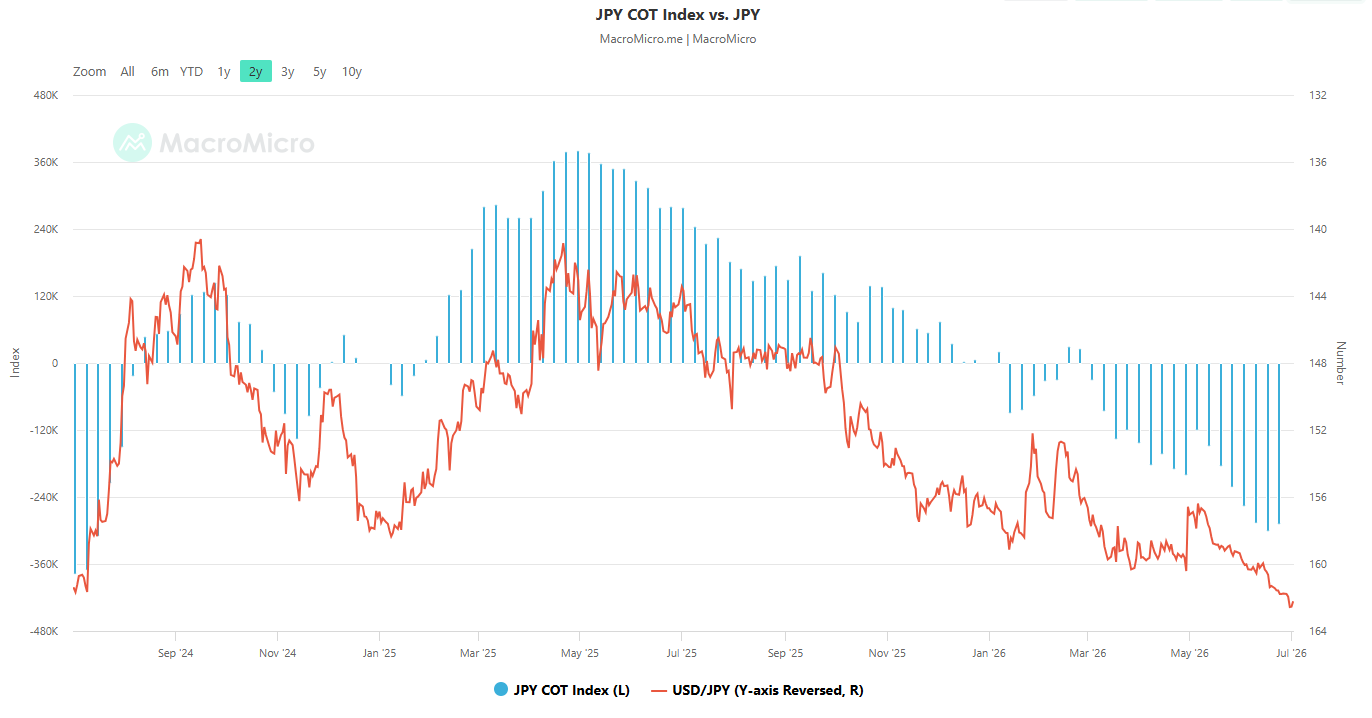
Also, large speculator net short Japanese yen positions in the FX futures market have reached a 2-year high, making a “deliberate intervention” more effective as the exit door is narrowing due to overcrowded short positions on the yen.
According to the latest data from the Commitment of Traders report as of 23 June 2026, the net short portion of JPY futures (large speculators less large commercials) has remained steady at -288,485 contracts, more than the 02 June 2026 print of -257,335 (see Fig 2.)
Hence, the Japanese authorities may use the Reuters news report to reduce speculative positions but not alter the major uptrend phase of USD/JPY (i.e., the Japanese yen’s major downtrend).
Watch the 160.90 support on the USD/JPY
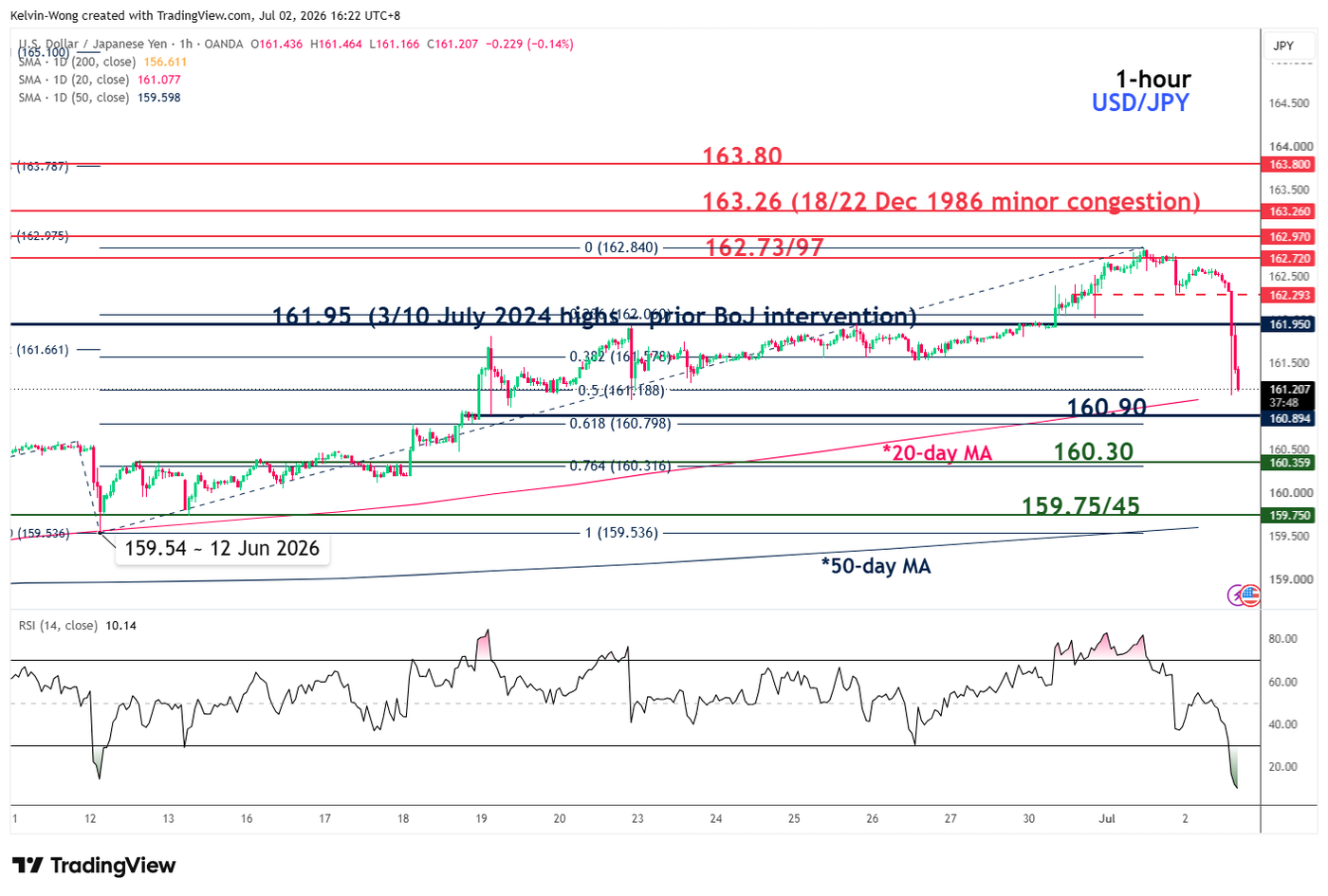
The latest bout of selling in USD/JPY (-0.7% intraday) remains above 160.90 key intermediate support (also the 20-day moving average, above it since 15 May 2026).
Only a break and an hourly close below 160.90 may trigger an intraday minor decline towards the next intermediate support at 160.30 and even a test on the 159.75/45 key medium-term support zone (also the 50-day moving average) (see Fig. 3).
On the flip side, a clearance and an hourly close above 161.95 reinstate the bullish tone on USD/JPY, targeting a retest of 162.73/97 before an assault on the next intermediate resistance at 163.26.
Opinions are the authors'; not necessarily that of OANDA Business Information & Services, Inc. or any of its affiliates, subsidiaries, officers or directors. The provided publication is for informational and educational purposes only.
If you would like to reproduce or redistribute any of the content found on MarketPulse, an award winning forex, commodities and global indices analysis and news site service produced by OANDA Business Information & Services, Inc., please refer to the MarketPulse Terms of Use.
Visit https://www.marketpulse.com/ to find out more about the beat of the global markets.
© 2026 OANDA Business Information & Services Inc.