







Tesla Q3 2026 Earnings Preview: Deliveries beat estimates

Tesla reports Q3 2026 earnings on October 21. While deliveries beat expectations, investors remain focused on margins, China demand, energy storage growth, and Cybercab regulatory hurdles.
Key takeaways
- Tesla beats Q3 delivery expectations: Tesla delivered 486,532 vehicles in the third quarter of 2026, exceeding analyst forecasts by 5.3%. Investors will now focus on profitability, automotive margins, and cash flow when the company reports earnings on October 21.
- Strong exports offset weakening demand in China: September wholesale sales of China-made Tesla vehicles rose 5% year over year to 95,366 units, driven by a 58% surge in exports. However, domestic sales declined 9%, highlighting persistent competitive and pricing pressures.
- Cybercab expansion offers growth potential but faces regulatory hurdles: Tesla is rapidly expanding its autonomous vehicle fleet in Texas, with Dallas emerging as a potential next market. However, safety requirements and an October 30 regulatory deadline could influence the pace of commercialization.
Tesla is scheduled to release its financial results for the third quarter of 2026 on October 21, after the close of trading on Wall Street. Investors will assess not only the performance of the company's core automotive business but also its progress in developing autonomous taxis and expanding its energy storage operations. Although September sales of China-made vehicles reached their highest level of the year, growth was driven primarily by exports, while demand in the domestic Chinese market remained under pressure. Meanwhile, Tesla continues to advance its Cybercab project, whose future depends on both technological capabilities and decisions by US regulators.
Tesla beats delivery expectations as investors await financial results
Tesla's upcoming earnings release will be one of the key events of the October reporting season for the US technology and automotive sectors. The company will present its detailed third-quarter financial results on October 21, providing investors with important information on revenue, profitability, and cash flow. Initial figures concerning Tesla's operating performance are already available. According to data released on October 211, the company delivered 486,532 vehicles in the third quarter, exceeding the previous analyst consensus of 461,974 units. This represents a result approximately 5.3% above expectations, although deliveries were still around 2.1% lower than a year earlier. Vehicle production totaled 464,391 units.
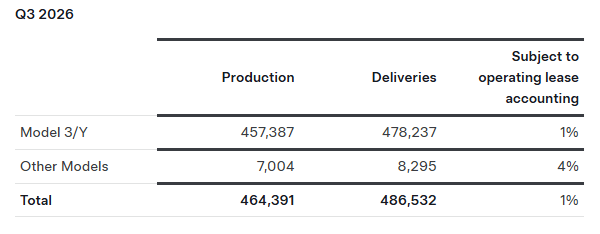
Beating delivery expectations is a positive signal, but it does not necessarily indicate an improvement in financial performance. The key question is whether Tesla managed to maintain healthy margins amid intense price competition. Higher vehicle sales do not automatically translate into proportional profit growth, particularly when additional demand is supported by discounts or more attractive financing terms. Investors will also focus on Tesla's ability to generate cash. The company is investing heavily in artificial intelligence, autonomous driving, and robotics, making the financial health of its core automotive operations an important factor in its ability to execute its long-term strategy.
Record September sales in China, but growth depends on exports
The situation in China's electric vehicle market remains an important factor in assessing Tesla ahead of its earnings release. In September, the company's Shanghai factory recorded its highest monthly wholesale sales volume of 2026, including vehicles intended for both domestic customers and export markets. Total sales reached 95,366 vehicles, representing a 5% increase compared with the same period last year. However, the headline improvement masks a significant divergence between domestic sales and exports. Tesla's exports from China increased by 58% year over year in September, reaching 30,529 vehicles. At the same time, domestic sales declined by 9% to 64,837 units. This means that September's wholesale sales growth was driven entirely by increased deliveries to overseas markets.
A similar pattern can be observed in the figures for the first nine months of the year. Total wholesale sales of China-made Tesla vehicles increased by approximately 23% to 743,060 units. Exports surged by more than 108% during this period, while domestic sales declined by nearly 12%. The growing importance of international markets has allowed the Shanghai factory to maintain strong operating volumes despite weakening local demand. Nevertheless, conditions in China's automotive market remain challenging. Tesla faces increasingly intense competition from domestic manufacturers offering a wide range of lower-priced electric vehicles. Reduced government purchase incentives and aggressive pricing strategies across the industry are adding further pressure. Tesla has also relied on discounts to support demand, which may negatively affect profitability.
For investors, the main question is therefore not only whether Tesla can sustain export growth from Shanghai, but also whether higher delivery volumes will translate into stronger financial results. Persistent pricing pressure could limit the benefits of increased vehicle sales.
Long-term forecasts point to higher vehicle sales and energy storage growth
Despite challenges in China, analysts expect Tesla to gradually increase global vehicle sales over the coming years. According to the consensus published by the company on September 292, deliveries are projected to reach approximately 1.77 million vehicles in 2026 and rise to 1.92 million in 2027. Longer-term forecasts suggest that Tesla could exceed 2 million annual deliveries in 2028 and reach around 2.7 million vehicles by 2030. Achieving these targets will require Tesla to maintain the competitiveness of its core models, stabilise demand across major markets, and continue expanding its operations. Increasing competition from both traditional automakers and Chinese electric vehicle manufacturers remains a major challenge.
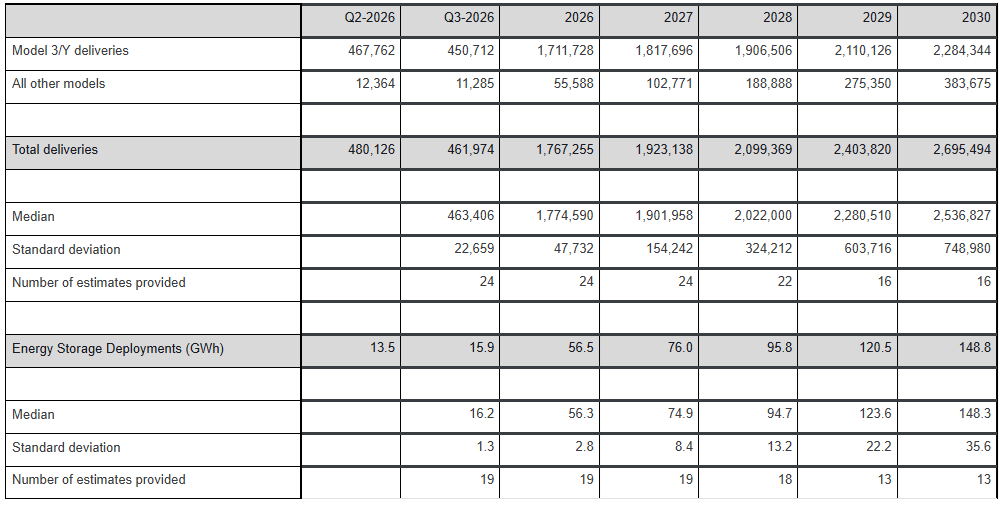
At the same time, energy storage is becoming an increasingly important part of Tesla's business model. During the third quarter, the company deployed energy storage systems totaling 13.7 GWh, compared with analysts' previous expectations of 15.9 GWh. Although the result fell short of forecasts, the segment's longer-term growth prospects remain promising. According to the September consensus, annual energy storage deployments are expected to reach 56.5 GWh in 2026 and increase to 148.8 GWh by 2030. This would represent more than a doubling of the business over four years.
Growing demand for energy storage, supported by the expansion of renewable energy generation and power infrastructure, could create significant opportunities for Tesla. The segment also plays an important role in diversifying revenue and reducing the company's dependence on electric vehicle sales. Ahead of the upcoming earnings report, investors will focus not only on the pace of expansion in Tesla's energy business but also on its profitability and ability to generate positive cash flow.
Cybercab expansion accelerates as Tesla prepares for the next stage of autonomous mobility
One of the most important pillars of Tesla's long-term strategy remains the development of autonomous transportation. The Cybercab project is intended to enable the company to enter the mobility services market with vehicles that do not require a traditional human driver. For investors, it is a central element of the argument that Tesla should be valued not simply as an automaker, but also as a company developing artificial intelligence-based technologies.
Cybercabs registered in Texas increased from 169 to 319, representing an addition of 150 vehicles. The materials also indicate that the fleet serving Austin has surpassed 300 vehicles, marking an eightfold increase in just 30 days. These figures suggest rapid expansion, although vehicle registrations do not necessarily correspond to the number of vehicles actively providing fully autonomous commercial services. Tesla's operations in Austin could serve as a foundation for expansion into additional US cities. Ashok Elluswamy, Tesla's head of AI software, has suggested that Dallas could become one of the next markets. However, the company has not announced a specific timeline for launching the service there.
Elon Musk has previously emphasized that the expansion of autonomous taxi operations will proceed gradually. Particular attention is being given to challenging driving scenarios, including railway crossings, complex intersections, and situations involving limited visibility. System safety remains one of the fundamental conditions for successful commercialization. For investors, the development of autonomous taxis carries significance beyond fleet expansion alone. The ultimate success of the project will depend on Tesla's ability to establish a service that can be scaled safely and profitably across multiple cities. Consequently, management commentary during the third-quarter earnings presentation regarding expansion plans, operating costs, and technological progress could prove particularly important.
Regulatory challenges could slow cybercab development, with October 30 marking a key deadline
The development of autonomous taxis also presents significant regulatory challenges. US National Highway Traffic Safety Administration (NHTSA) has required Tesla to respond to 21 questions concerning Cybercab safety certification. One of the central issues involves whether a vehicle designed without conventional pedals complies with US safety regulations, particularly those governing braking systems.
Tesla reportedly received an extension until October 30, 2026, to submit its responses, despite requesting additional time until November 20. This means that just nine days after its quarterly earnings release, the company faces another important deadline related to the future of its autonomous vehicles. Regulatory requirements could directly affect the pace of Cybercab commercialization. Even substantial technological progress does not guarantee rapid deployment on a large scale if the vehicle's design and operating systems fail to meet applicable safety standards.
From an investment perspective, the key question is whether Tesla can transition from expanding test fleets and limited deployments to a business model capable of generating recurring revenue. Regulatory delays or required vehicle design modifications could postpone the expected financial benefits.
Tesla shares rebound, but investor sentiment remains cautious
The improvement in September wholesale sales in China generated a positive market reaction. Following the release of the figures, Tesla shares gained as much as 2.05% on Friday. The stock finished the previous week 3.27% higher, reaching $382.70.
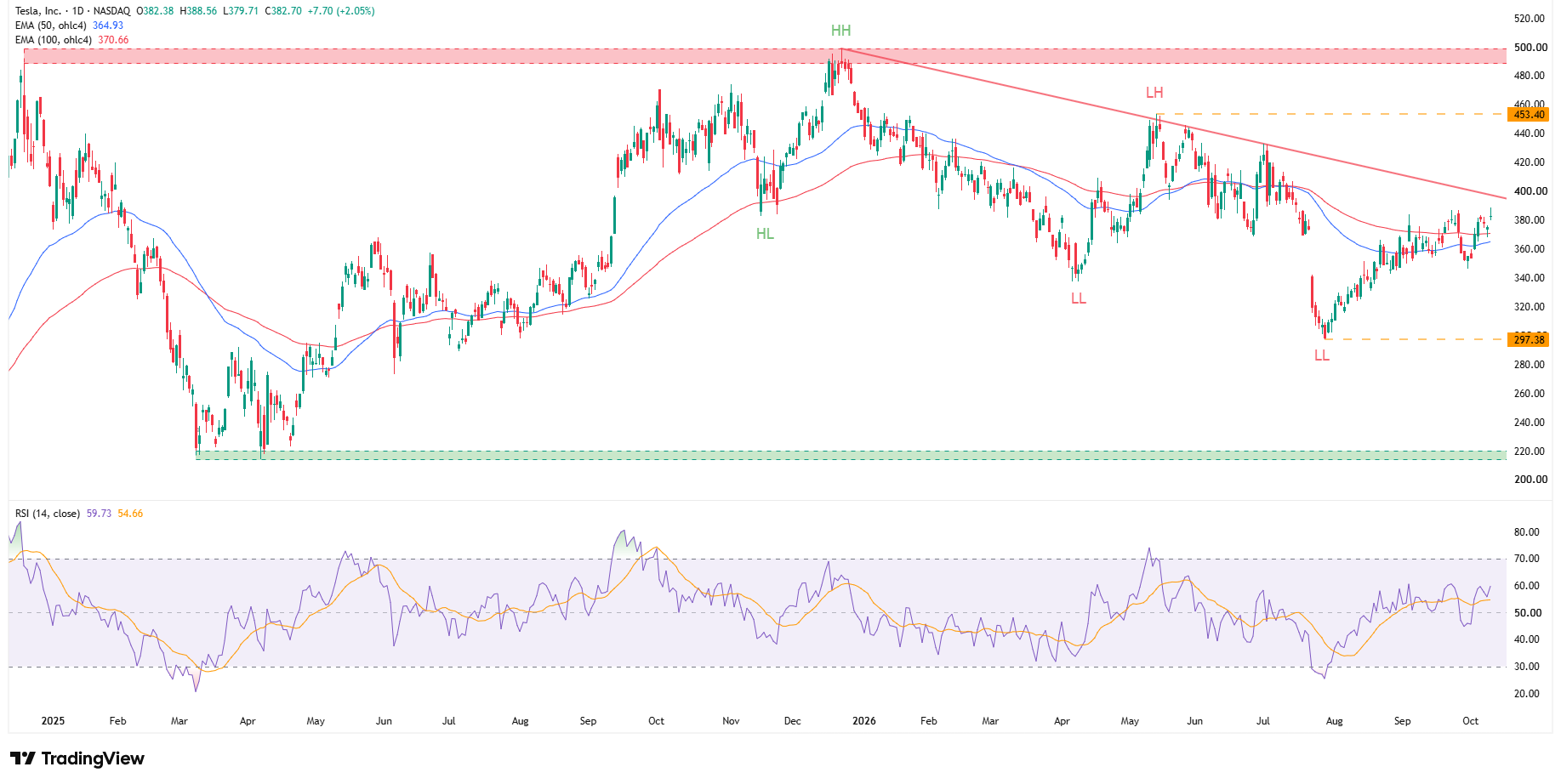
However, the short-term rebound does not change the fact that Tesla shares remain under pressure. Stock has declined by approximately 15% since the beginning of 2026, making it the weakest performer among the Magnificent Seven companies. Investor sentiment continues to be influenced by questions about Tesla's ability to deliver on its ambitious technology projects and turn them into profitable businesses. Autonomous driving, artificial intelligence, and robotics could create new revenue streams, but they also require substantial investment.
As a result, the upcoming earnings report will be assessed not only in terms of vehicle sales but also through Tesla's ability to finance future growth without significantly weakening its cash flow. Investors are likely to pay particular attention to management commentary on planned capital expenditures, automotive margins, and the timetable for launching new services. Given the high expectations surrounding autonomous mobility, even strong vehicle delivery figures may not be enough to produce a sustained improvement in sentiment unless Tesla also offers a convincing outlook for profitability.
Tesla Q3 Earnings: what will matter most to investors?
Tesla's financial results on October 21 will provide an opportunity to assess whether the company can translate relatively solid operating performance into stronger financial fundamentals. Vehicle deliveries exceeded analysts' previous expectations, but persistent pricing pressure and declining domestic sales in China remain significant challenges. At the same time, businesses beyond traditional automotive manufacturing are becoming increasingly important to Tesla's investment outlook. Energy storage could gradually account for a larger share of the company's operations, while Cybercab remains a project with substantial potential but also considerable technological and regulatory uncertainty.
The most important question for investors will therefore be whether Tesla's core automotive business can maintain sufficient profitability and generate the cash required to fund new initiatives. In the near term, automotive margins, cash flow, and guidance for the fourth quarter could determine the market's reaction to the earnings release. Over the longer term, the company's valuation will increasingly depend on its ability to transform autonomous driving and artificial intelligence projects into scalable, revenue-generating businesses. The upcoming earnings report will therefore reveal not only the current state of Tesla's business, but also the strength of the financial foundations supporting its ambitious vision for the future.
Footnotes
1 https://ir.tesla.com/press-release/tesla-third-quarter-2026-production-deliveries-and-deployments
2 https://ir.tesla.com/press-release/delivery-consensus-third-quarter-2026
The content here is for educational and informational purposes only. This material is not investment advice or a recommendation or suggestion of any investment strategy, and it does not provide investment advisory services. OANDA is not responsible for any investment decisions made based on this content. Investing involves the risk of a loss of capital. Past performance does not guarantee future results.
Latest blog posts:


Start trading now with fast account opening.
Sign-up now to trade the most active markets
Open account

