







Understanding grid trading: A complete guide

As a trading strategy, grid trading gives traders the opportunity to make consistent profits from market volatility without needing to predict market direction.
Grid trading is an automated strategy that places buy and sell orders at set intervals around a predefined price range. This systematic approach aims to capture small profits from continuous price fluctuations within a specific channel for traders. When markets move sideways with high volatility, structured strategies like grid trading can help you systematically capture price swings without constantly watching the charts.
What is grid trading?
Grid trading is an automated trading strategy for financial markets. It sets up a "grid" of buy and sell orders at predefined price levels within a selected price range.
The main goal of grid trading is to profit from market volatility and price fluctuations, almost running in the background, eliminating tricky guesswork for the market and instead, continuously triggering trades in order to collect steady profits. It works best in ranging markets, where asset prices bounce back and forth between clear support and resistance levels.
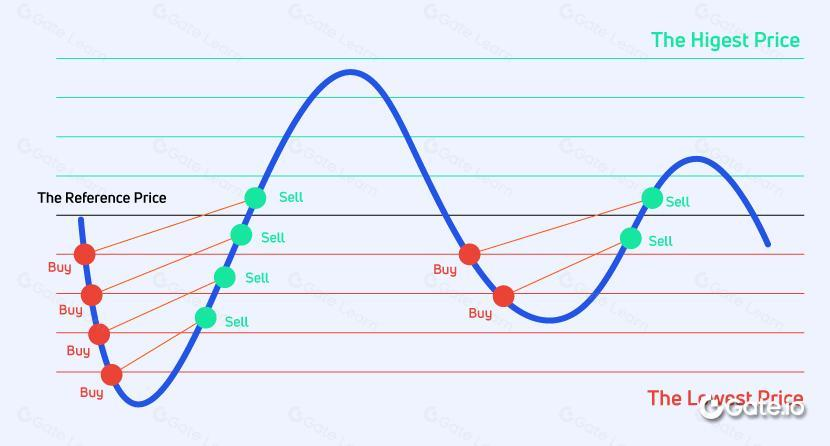
How does grid trading work?
Grid trading works by placing staggered buy orders below the current market price and sell orders above it. As the price drops, your trades are enacted. As the price rises, your sell orders execute. Whenever an order fills, the system automatically places an opposing order at the next grid level.
For example, if a buy order triggers at 1.0800, the system sets a corresponding sell order at 1.0820 to lock in profit when the price rebounds.
Grid types
There are multiple grid types and each grid trading strategy has a unique method. Here are some of the most common options:
- Static grid: The grid levels are fixed and do not change, no matter how the price moves
- Dynamic/adaptive grid: The levels adjust based on price movements (or indicators), adapting to the market conditions
- Proportional grid: The distance between levels changes with the asset’s price
- Expanding grid: The distance between levels increases as the price moves further from the initial level
- Constrained grid: Trading is limited to a narrow range. If the price moves outside this range, the grid may be reconfigured
- Multi-level grid: The grid is divided into multiple layers, with different parameters, offering more flexibility
- Bi-directional grids: Mostly used in forex trading, where traders can open both long and short positions at the same time
- Arithmetic grid: Each line is a fixed "price" apart (e.g., every 2 points)
- Geometric grid: Each line is a fixed "percentage" apart (e.g., every 1%)—better suited to instruments with large price swings
- Neutral grid: Places both buy and sell orders and trades both ways—best for a range with no clear direction
- Long / short grid: Places orders in a single direction only (bullish or bearish); used when you buy and hold a directional view, but it does increase the risk of being wrong in direction
Using advanced indicators can add even more flexibility to your grid trading strategy. For example, you can set grid levels based on significant peaks in the market profile. Beginner traders might use the arithmetic and neutral grid strategy more, as it’s simple in its execution. Geometric grids and directional grids are more flexible, but demand a clearer read of the instrument's volatility, so are better wielded by more experienced traders.
Ideal market conditions for grid trading
Grid trading is most effective when deployed in suitable environments, specifically:
- Ranging consolidation - the strategy thrives in sideways markets rather than directional ones.
- Channel volatility - constant price fluctuations within a defined price channel are highly beneficial, allowing for frequent order execution.
- Trend avoidance - it is generally not recommended for strongly trending markets. An aggressive price breakout from the grid range can lead to significant losses without proper risk mitigation.
The grid trading system
To set up a grid strategy, you’ll need to configure four main elements:
The price range defines the highest price limit and lowest price limit where your trades will take place, ensuring the trades execute strictly inside these boundaries.
- The grid interval that specifies the fixed price distance or gap between each individual order.
- The number of grids, which represents the total count of buy and sell levels created across your range, where a higher density leads to more frequent trading activity.
- Position size decides the precise amount of money or capital assigned to each individual order level.
Grid trading across markets
While the core mechanics of grid trading remain consistent, its implementation can be easily tailored to various financial environments. Different asset classes offer unique market conditions that directly influence how these automated strategies perform.
Crypto grid trading
Cryptocurrency grid trading is popular with traders because crypto markets are famous for high volatility, sharp price movements, and twenty-four-seven market hours of operation. This means that by using an automated system, it can capture overnight price fluctuations traders may otherwise miss.
Forex grid trading
Forex grid trading takes advantage of major currency pairs like EUR/USD or EUR/GBP, which regularly trade within well-defined ranges during specific trading sessions. Setting up grids around these historical support and resistance zones lets forex traders systematically profit from intraday range-bound behavior.
The key principles of grid trading
Grid trading relies on a few key concepts that make it unique. Instead of searching for one winning trade, the system aims to lock in smaller but frequent gains repeatedly as the market oscillates back and forth.
This approach capitalises on sideways markets, taking advantage of the reality that financial assets spend much of their time bouncing inside a horizontal channel rather than surging strongly in one direction or the other. Overall, the grid trading system operates on complete automation so that once you configure your settings, the software automatically opens and closes orders within trading hours, without needing manual oversight.
Benefits of grid trading
- Grid trading gives traders the ability to have consistent range returns on their trades, by getting steady income while prices move predictably inside set boundaries.
- Automation also gives traders emotion-free execution, removing impulse or hesitation that can impact trading plans.
- An automated trading system means traders can trade on the go, without needing to be present on their account. Grid trading can capture overlooked intraday swings, catching small price movements throughout the day and night.
- Grid trading also offers structured risk management by splitting traders total investment across multiple small entry levels rather than risking capital on a single entry price.
The limitations and risks of grid trading
Despite its benefits, grid trading does carry clear limitations and risks that traders need to be aware of. The main danger of grid trading is breakout risk, which happens when the market enters a powerful trend that breaks far past a trader’s upper or lower price boundaries. When this happens, the grid stops closing profitable trade pairs and gives traders unrealised losses on open orders.
Another risk is that keeping multiple active grid orders locks up tied-up margin, restricting capital that could be used for other, maybe more profitable, market opportunities. Traders also risk over-optimisation by fine-tuning grid settings strictly on historical data, leading to failed strategies when market dynamics change.
Lastly, high trade frequency can cause spread and financing costs to accumulate quickly, allowing broker commissions and overnight holding fees to take away from your profits.
FAQ
- How do I know if market conditions are suitable for grid trading?
Grid trading performs best in range-bound or consolidating markets with clear support and resistance levels. Look for assets that aren’t in a strong, sustained uptrend or downtrend. Technical indicators like Bollinger Bands or Average True Range (ATR) can help spot periods of sideways price action and volatility within a defined range.
- What are the main risks associated with using a grid trading system?
The primary risk is a strong market trend that moves significantly beyond the established grid's upper or lower boundaries. This can lead to substantial unrealised losses if trades aren’t closed or the grid is not adjusted. Trading costs from frequent execution and capital tied up in open positions are also significant concerns.
- Can grid trading be used effectively in both crypto and forex markets?
Yes. Cryptocurrencies' high volatility and twenty-four-seven nature can offer frequent trading opportunities for grid traders. Forex markets also show ranging behavior, making them a good grid trading instrument.
- What makes a "dynamic" grid trading strategy different from a standard one?
A dynamic grid strategy automatically adjusts its parameters—such as the price range or grid spacing—in response to real-time market conditions. Unlike a static grid with fixed levels, a dynamic approach uses algorithms or technical indicators to shift the grid as support and resistance levels evolve.
- What key factors should I consider when setting up my first grid trading strategy?
Traders should carefully analyse the asset's historical price action to define a realistic price range and grid interval. Determine an appropriate position size for each order relative to your total account capital to manage leverage safely, and establish a clear stop-loss or risk limit to protect your capital if the price breaks out of your defined grid range.
This article is for informational purposes only and does not constitute investment advice or a recommendation. CFDs are complex instruments and carry a high risk of rapid loss of capital due to leverage. Please ensure you understand the risks involved. Past performance is not indicative of future results.
Latest blog posts:


Start trading now with fast account opening.
Sign-up now to trade the most active markets
Open account

