











EUR/USD Price Forecast: Bulls continue to defend 1.0950
- EUR/USD rises to near 1.0996 as the US Dollar struggles to extend the rally.
- The Fed is almost certain to hike interest rates in the December meeting.
- Investors keenly await flash Eurozone/US private sector PMI data.
The Euro (EUR) is up 0.3% to near 1.0996 against the US Dollar (USD) during the European trading session on Monday, but is still close to its 18-month low of 1.0953 posted last week. The major currency pair gains as the US Dollar struggles to extend the rally; however, the outlook of the latter remains firm due to expectations that the Federal Reserve (Fed) will deliver back-to-back interest rate hikes in the near term.
As of writing, the US Dollar Index (DXY) is down 0.2% to near 103.64, but is close to its 19-month high of 104.00 posted last week.
Strategists at Rabobank highlight that the front end of the curve is firmly aligned with further Fed tightening, noting that “the OIS curve implies that investors are positioned for a full hike in December, followed by close to 70% of a 25bp hike priced in for the January meeting.” They add that this configuration is “in line with Waller’s comments, after having moved from one of the most hawkish to one of the most dovish FOMC members and now back among the most hawkish.”
On the basis of hawkish Fed expectations, market experts see the Euro falling further against the US Dollar.
Fed hawkishness underpins Dollar as Nordea targets lower EUR/USD
Strategists at Nordea argue that “a more hawkish Fed will support the Dollar, strengthening our case for a lower EURUSD going forward.” The bank notes that “statements from certain members over the week have also confirmed that market expectations of two to three rate hikes before summer are reasonable, in line with our Fed call.” Against this backdrop, Nordea stresses that “our baseline for the EUR/USD remains robust, and we continue to see further downside in the pair, to 1.08 during H1 2027.”
Meanwhile, investors await preliminary Eurozone/United States (US) flash Purchasing Managers’ Index (PMI) data for November, which will be released during the day.
EUR/USD Technical Analysis
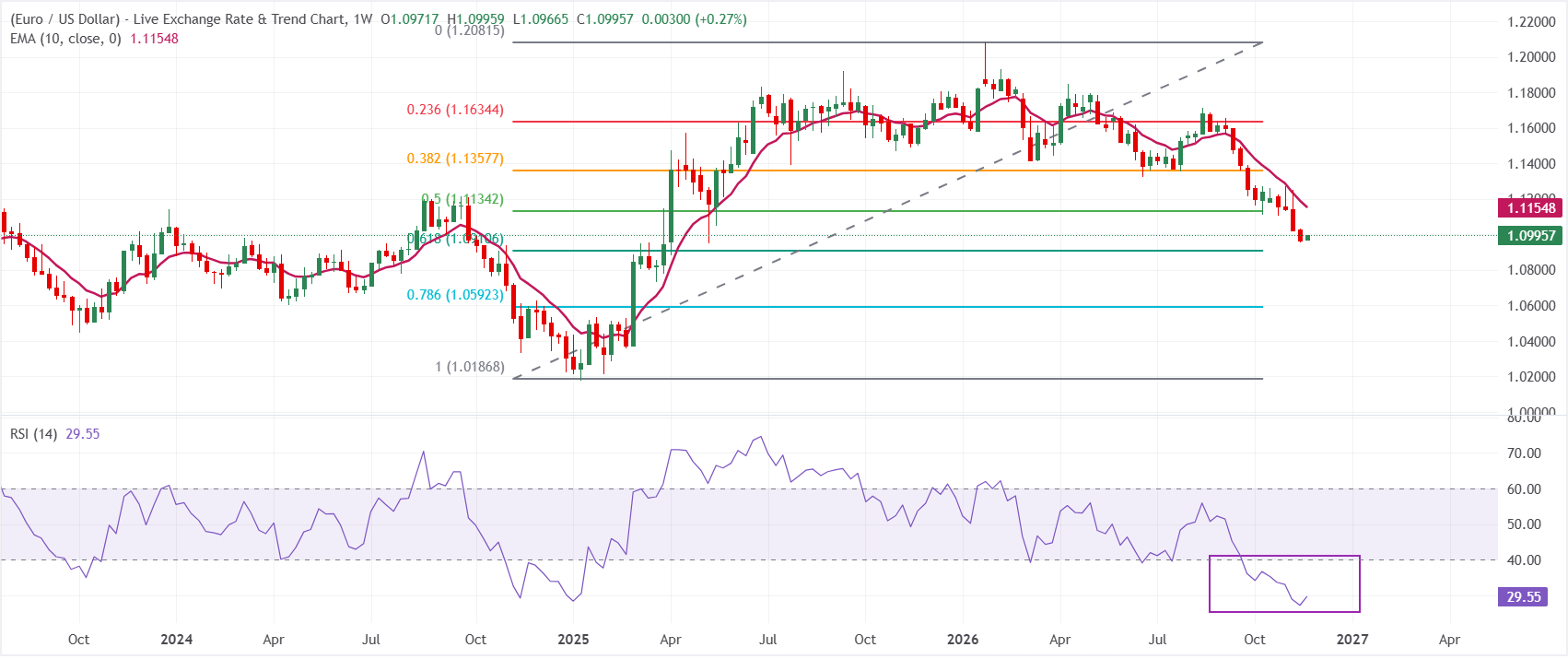
In the weekly chart, EUR/USD trades at 1.0996. The pair maintains a bearish bias as it holds beneath the 10-week exponential moving average (EMA) at 1.1155, keeping the broader downtrend intact after a prolonged decline from the 1.20 area. Weekly Relative Strength Index (RSI) sits near 29.6 in oversold territory, hinting that downside momentum is stretched, yet the failure to reclaim the 50.00% Fibonacci retracement at 1.1134 reinforces the notion of persistent selling pressure on rallies.
On the topside, initial resistance is located at the 50.00% Fibonacci retracement at 1.1134, followed closely by the 10-week EMA at 1.1155, which together form a key supply zone; a weekly close above this area would be needed to ease the immediate bearish tone. Further north, additional barriers align at the 38.20% retracement at 1.1358, then the 23.60% level at 1.1634, ahead of the cycle high region near the 0.00% retracement at 1.2082. On the downside, first support emerges at the 61.80% Fibonacci retracement at 1.0911, with subsequent floors at 1.0592 (78.60%) and 1.0187 (100.00%), where buyers may attempt to stem deeper losses if the current slide extends.
(The technical analysis of this story was written with the help of an AI tool. Know more.)
Fed FAQs
What does the Federal Reserve do, how does it impact the US Dollar?
Monetary policy in the US is shaped by the Federal Reserve (Fed). The Fed has two mandates: to achieve price stability and foster full employment. Its primary tool to achieve these goals is by adjusting interest rates. When prices are rising too quickly and inflation is above the Fed’s 2% target, it raises interest rates, increasing borrowing costs throughout the economy. This results in a stronger US Dollar (USD) as it makes the US a more attractive place for international investors to park their money. When inflation falls below 2% or the Unemployment Rate is too high, the Fed may lower interest rates to encourage borrowing, which weighs on the Greenback.
How often does the Fed hold monetary policy meetings?
The Federal Reserve (Fed) holds eight policy meetings a year, where the Federal Open Market Committee (FOMC) assesses economic conditions and makes monetary policy decisions. The FOMC is attended by twelve Fed officials – the seven members of the Board of Governors, the president of the Federal Reserve Bank of New York, and four of the remaining eleven regional Reserve Bank presidents, who serve one-year terms on a rotating basis.
What is Quantitative Easing (QE) and how does it impact USD?
In extreme situations, the Federal Reserve may resort to a policy named Quantitative Easing (QE). QE is the process by which the Fed substantially increases the flow of credit in a stuck financial system. It is a non-standard policy measure used during crises or when inflation is extremely low. It was the Fed’s weapon of choice during the Great Financial Crisis in 2008. It involves the Fed printing more Dollars and using them to buy high grade bonds from financial institutions. QE usually weakens the US Dollar.
What is Quantitative Tightening (QT) and how does it impact the US Dollar?
Quantitative tightening (QT) is the reverse process of QE, whereby the Federal Reserve stops buying bonds from financial institutions and does not reinvest the principal from the bonds it holds maturing, to purchase new bonds. It is usually positive for the value of the US Dollar.