







Intel stock forecast 2026: Is chip demand booming with AI?

Since the launch of its foundry turnaround plan, Intel stock has moved through an unusually wide range: a rally powered by AI infrastructure spending, punctuated by sharp pullbacks whenever the manufacturing story wobbles. Is each correction a healthy reset, or the start of a longer trend lower? This forecast maps both paths.
Where Intel stock sits right now
Structurally, Intel trades in a wide, sentiment-driven range shaped by its transformation from a struggling PC-chip maker into a would-be AI foundry. Rallies have been steep, but so have the drawdowns that follow any doubt about manufacturing execution.
Three ongoing forces shape the current price regime. First, the foundry business still burns cash while the market questions when external chipmaking reaches profitable scale. Second, AMD and Nvidia contest the data-centre segment Intel needs most. Third, sector-wide anxiety about the durability of AI capital spending amplifies every dip.
The durable upside catalyst is Intel's advanced-node foundry roadmap. If its leading-edge manufacturing process attracts major external customers, it would justify a structurally higher valuation.
Whichever way the next leg breaks, you can trade Intel long or short with OANDA.
Intel stock forecast 2026
The defining feature of Intel’s analyst coverage is the sheer width of the spread. Twelve-month targets range from around $74 to $200, with the consensus clustered in the mid-to-high $90s. A spread that wide is not indecision: it is two incompatible theses priced side by side.
The bull argument treats Intel as an emerging AI foundry: data-centre revenue growing at its fastest pace in over a decade, improving yields, and re-rating potential on any marquee external customer commitment.
The bear argument treats the same company as a capital-intensive turnaround whose foundry ambitions consume billions while external customers stay on the sidelines. Bears argue the 2026 rally has already priced in a turnaround that has not yet materialised.
Three scenarios for the next 12 months:
- Base case ($100 to $140): Turnaround on track, data-centre growth continues, foundry progress steady. The stock consolidates in a broad range.
- Bull case ($150 to $200): Conditional on a high-volume external foundry commitment from a major chip designer; this remains a scenario assumption, not a near-term certainty.
- Bear case ($45 to $90): Conditional on yield setbacks, retreat from foundry ambitions, or a broad AI capex slowdown.
In the coming months, Intel remains a company with the potential for a rebound, but it will be crucial to see confirmation of improved results and the effective implementation of its strategy in the areas of AI and chip manufacturing. If the company maintains positive operational momentum, the stock price may gradually move higher, although increased volatility should be expected along the way. My base-case scenario is for moderate growth, with the biggest risks remaining weaker margins, high capital expenditures, and a deterioration in sentiment across the entire semiconductor sector.
Krzysztof Kaminski, Market Analyst
What could move the stock
Data Centre and AI (DCAI) revenue growth rate. The metric to watch is the pace of year-on-year growth in this segment, because it shows whether the shift from AI training to inference is translating into sustained, accelerating CPU demand, or whether the initial wave is moderating. Q2 2026 DCAI revenue came in at approximately $6.3 billion, beating estimates, but the direction of travel matters more than any single quarter's number.
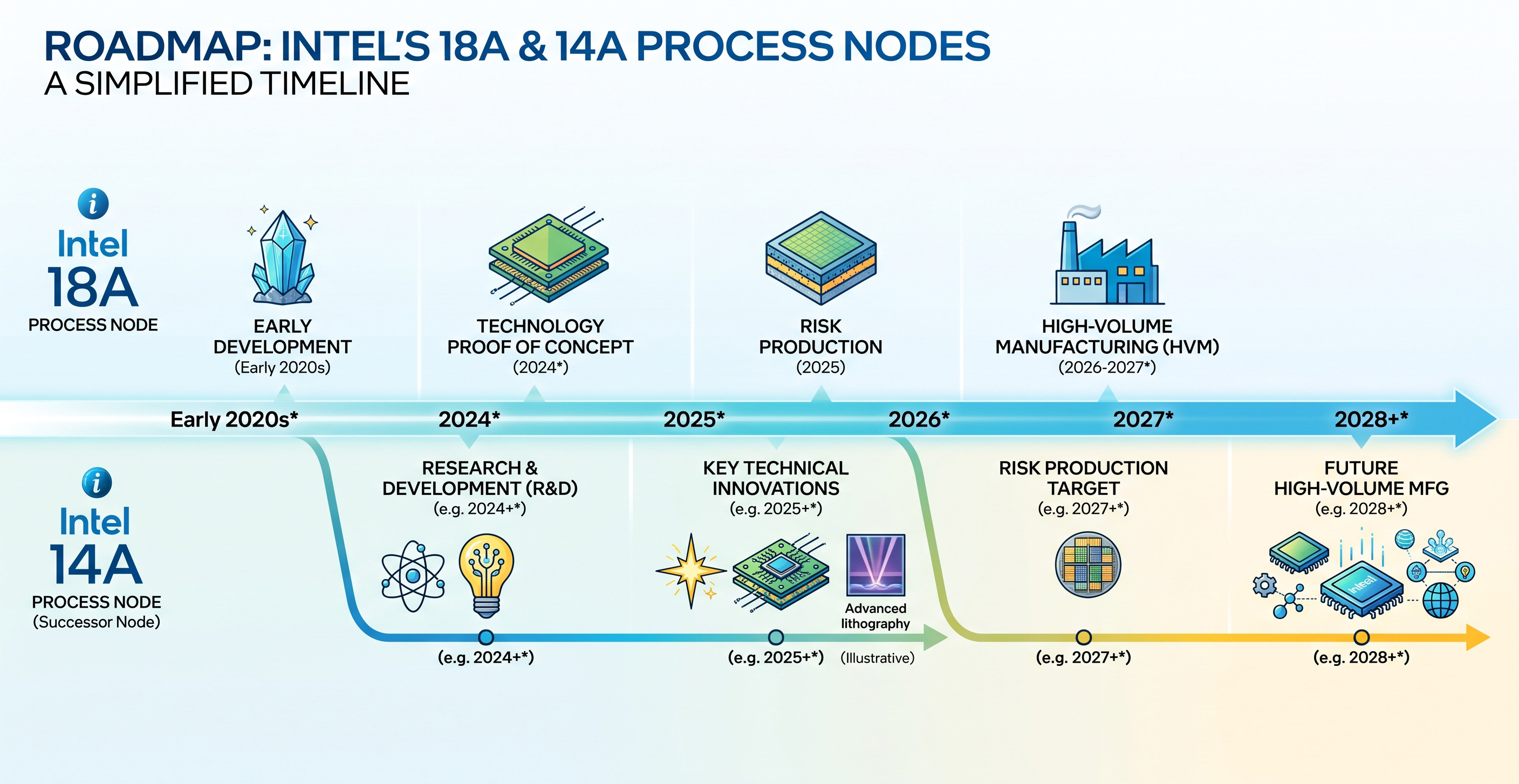
External foundry commitments and 18A yield progression. The metric to watch is the ratio of external to internal foundry revenue, because Intel's valuation re-rating assumes outside chipmakers will eventually manufacture at its fabs. Yield rates and defect density at 18A, and early indicators for 14A, are the most durable signal of whether that assumption is on track.
Forecast outlook
Beyond twelve months, Intel's trajectory depends on execution over years, not quarters.
Medium-term outlook (3 to 5 years)
Most analysts do not publish targets this far out. Those who model it rely on DCF estimates that swing enormously with foundry margin assumptions; the model choice matters more than the number. Where longer-horizon models have been published, they tend to show intrinsic values materially above current market prices, but only under assumptions that external foundry revenue scales significantly and operating losses convert to free cash flow within the next few years. Those assumptions are the entire debate.
The bull case requires three factors to compound together: 18A and 14A reaching profitable, high-volume yields that attract and retain external customers; at least two or three anchor customers committing multi-year foundry volumes; and AI-driven data-centre demand staying strong enough to sustain utilisation across Intel's expanded fab network. Each reinforces the others: customers follow yields, and utilisation drives the margins that make the investment case close.
If those factors do not compound, the likelier outcome is not collapse but stagnation: a range-bound stock earning ordinary returns in a capital-heavy business that never quite delivers on its foundry ambitions.
Long-term outlook (10+ years)
An immediate caveat: any ten-year price target for a company mid-transformation is speculation dressed up as analysis. Some algorithmic forecasting services publish long-dated Intel numbers with apparent precision, typically extrapolating past price patterns into decade-horizon figures. This methodology cannot anticipate the technology transitions, competitive shifts, and geopolitical developments likely to define the semiconductor industry over that timeframe. See our algorithmic trading guide for context on what systematic models can and cannot do.
Scenario framing is more honest than numeric targets. If Intel establishes itself as the credible Western alternative to TSMC at leading-edge manufacturing, the business is materially larger than today. If foundry ambitions are scaled back, the outcome is considerably flatter.
Concrete structural risks: TSMC's entrenched process lead and customer ecosystem; competitive pressure from AMD, Nvidia, and Arm-based designs; and export controls and subsidy politics that cut both ways. A specific price target at this horizon is closer to a guess than a forecast.
Summary
Base case: $100 to $140. Bull case: $150 to $200, conditional on a marquee external foundry win. Bear case: $45 to $90 if yields slip or AI spending cools. Both the medium- and long-term outlooks hinge on the same shared risk: whether external customers ever commit to Intel's fabs at scale.
The next catalyst is Intel's Q3 2026 earnings, which analysts expect in late October, though no official date has been confirmed
Trade Intel with OANDA ahead of that date, long or short. For broader context, see our AI stock forecast guide.
This article is for informational purposes only and does not constitute investment advice or a recommendation. CFDs are complex instruments and carry a high risk of rapid loss of capital due to leverage. Please ensure you understand the risks involved. Past performance is not indicative of future results.
Latest blog posts:


Start trading now with fast account opening.
Sign-up now to trade the most active markets
Open account

